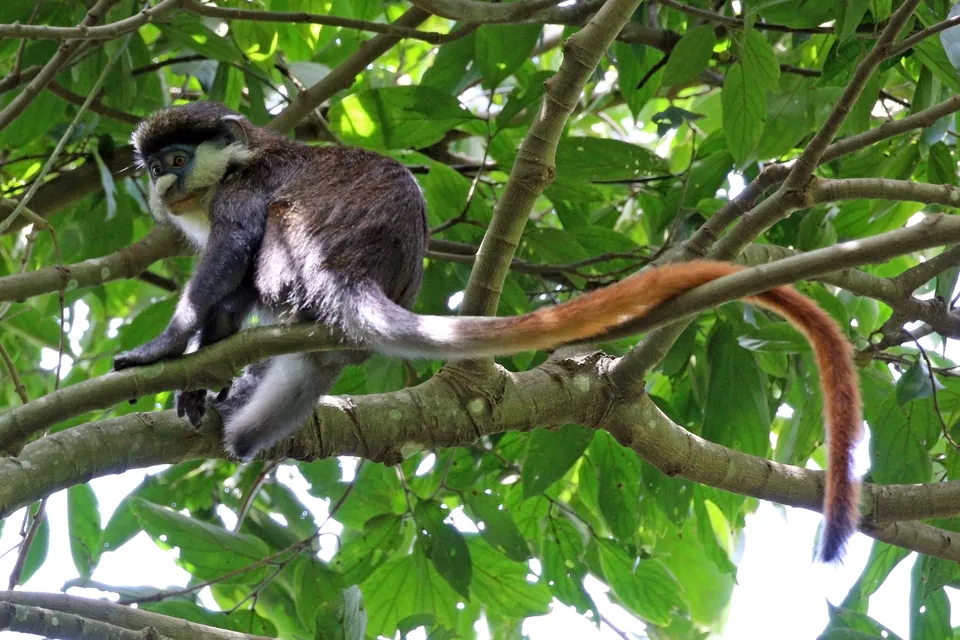
If you walk in almost any forest in western Uganda, a small dark face with a bright white spot on the nose will peer down at you. That’s the red-tailed monkey. It’s common, quick and curious, and it’s often the first monkey visitors learn to name.
Name and classification
- Common names: red-tailed monkey, redtail, red-tailed guenon, Schmidt’s guenon, black-cheeked white-nosed monkey.
- Latin name: Cercopithecus ascanius. Five subspecies are recognised, and the one in Uganda is C. a. schmidti, which has the widest range of them all.
- Family: Cercopithecidae. It’s a guenon, like the blue and L’Hoest’s monkeys.
- IUCN status: Least Concern.
Native origin
Red-tailed monkeys live in the tropical forests of Central and East Africa: DR Congo, the Central African Republic, South Sudan, Angola, Zambia, Rwanda, Tanzania, Kenya and Uganda, and possibly Burundi. In Uganda they’re found in most of the larger forests in the west and centre, including Kibale, Budongo, Bwindi, Kalinzu, Maramagambo, Semuliki and Mabira.
Physical appearance
This is a small monkey. Males weigh about 3–4.5 kg and females about 2.7–3.6 kg, with a body of roughly 30–60 cm and a tail that can be longer than the body. The body is dark grey to black with a speckled look. The giveaways are the heart-shaped white spot on the nose, white cheeks edged in black, and the underside of the tail, which turns reddish chestnut towards the tip. In poor light, look for the white nose first. Infants are paler and greyer than adults, and the red on the tail gets stronger as they grow.
Habitat and diet
They live in lowland and mid-altitude forest, including secondary forest, forest edges and swampy forest. They handle disturbed habitat better than many forest monkeys, which helps explain why they’re so common. Fruit is the main food, figs especially. When fruit is scarce they switch to leaves, flowers and lots of insects, which they pick off leaves and bark with quick hands.
A fruiting fig is the place to wait. When a big fig is ripe, red-tails gather in it from early morning, often with hornbills, turacos and other monkeys, and the patter of dropped fruit gives them away. Because they eat so much fruit and then move on, they spread seeds through the forest, helping the very trees they rely on.
Behaviour and special abilities
- Cheek pouches: like other guenons they have stretchy cheek pouches. They stuff them with fruit, then move somewhere safer to eat.
- Family groups: groups usually have 7 to 30 animals, with one adult male, several females and their young.
- Good mixers: they often travel and feed alongside other species, especially red colobus and blue monkeys. Mixed groups spot predators sooner.
- Close cousins: red-tails and blue monkeys sometimes groom each other and can even interbreed; hybrids have been seen at Gombe in Tanzania.
- Watching the sky: crowned eagles are a serious threat to small forest monkeys, so red-tails rarely sit exposed at the top of the canopy for long.
- Quick and shy: they move fast through the mid-canopy and give sharp alarm calls when an eagle passes over.
Where to see red-tailed monkeys in Uganda
- Kibale National Park and Bigodi Wetland Sanctuary.
- Budongo Forest and Mabira Forest.
- Bwindi and Kalinzu Forest.
Mornings are best. Walk slowly, listen for soft chirps and the rustle of a troop moving through the mid-canopy, and look for that white nose. Binoculars help a lot, because red-tails rarely come low for long.
You’ll often see them on a chimpanzee trek. For the shy ground-dweller of the same forests, read about L’Hoest’s monkey, and see primates of Uganda for the rest.
Found this useful? Send it to someone planning a trip.