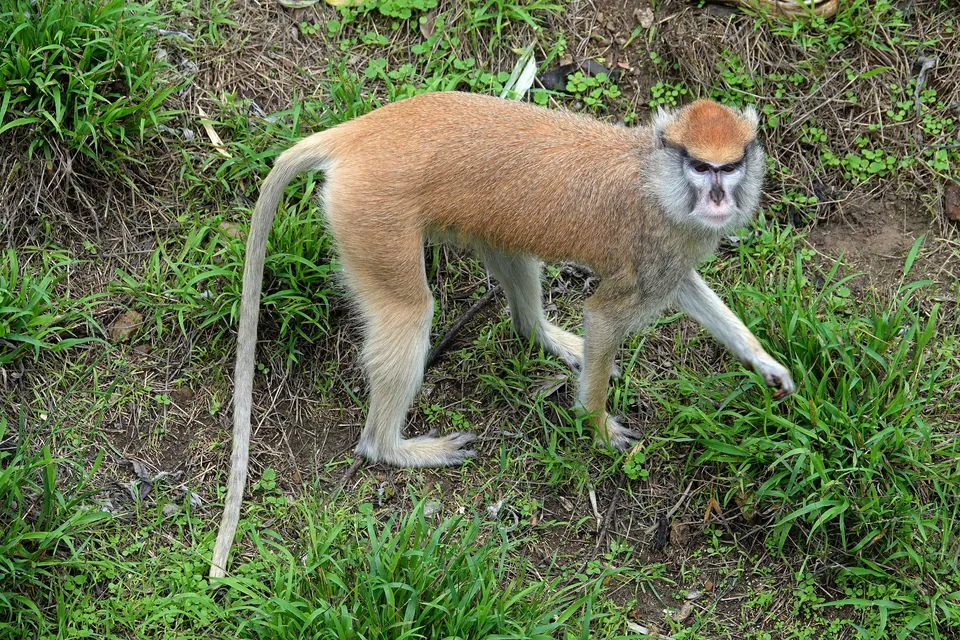
On the open grasslands of northern Murchison or Kidepo, you might see a reddish monkey standing up on its back legs in the grass, looking around like a meerkat. Then it drops down and runs, and you realise it’s faster than anything else in its family. That’s the patas monkey.
Name and classification
- Common names: patas monkey, common patas monkey, hussar monkey. The hussar name refers to the smart uniforms of old cavalry soldiers, matching the monkey’s red coat and white moustache.
- Latin name: Erythrocebus patas. A 2017 study proposed splitting the patas into three species, and the IUCN now uses that split. The other two, the Blue Nile patas and the southern patas, live outside Uganda’s main patas areas.
- Family: Cercopithecidae, closely related to the vervets.
- IUCN status: Near Threatened, because of habitat loss and declining numbers across much of its range.
Native origin
The patas lives in the semi-arid savanna belt south of the Sahara, from Senegal across West and Central Africa to East Africa. In Uganda it’s a monkey of the drier north. The first long field study of wild patas monkeys was done in Uganda in the 1960s. Today the best places to look are the northern bank of Murchison Falls National Park and Kidepo Valley National Park.
Physical appearance
The patas is tall and slender, with long legs built for running. The back and crown are a reddish brown and the underparts and limbs are greyish white. There’s a black brow and nose and a white moustache around the mouth. Males are about twice the size of females, averaging about 12 kg against 6.5 kg, and adult males have a blue scrotum. Infants are born dark and turn reddish over about six months. Compared with a vervet, a patas looks leggy, redder and much more upright.
Habitat and diet
Patas prefer wide open country: grassland, wooded savanna, thorn scrub and steppe. They only go into woodland near open ground. In Uganda their habitat includes savanna, woodland and thicket. They feed mostly on the ground, eating insects, tree gum, seeds, fruit, flowers and tubers. Acacias matter a lot. In one Kenyan study, gum and insects, many of them from whistling-thorn acacias, made up almost two-thirds of the diet.
Behaviour and special abilities
- Speed: patas can run at up to about 55 km/h, the fastest of any primate. Instead of climbing a tree when danger comes, they usually run.
- Lookouts: they scan constantly, often standing on their hind legs or sitting on a termite mound or low branch to see over the grass.
- One-male groups: a group can have up to about 60 animals, mostly females and young, with just one adult male for most of the year. In the breeding season other males move in for a few weeks.
- Females lead: it’s the females who decide where the group goes. Young males leave at about two to four years old and live alone or in bachelor groups.
- Quiet and spread out: they call much less than most monkeys, and at night each one usually sleeps in a separate tree, which makes it harder for predators to find the group.
- Long commutes: for their size, patas travel further each day and use bigger home ranges than almost any other primate.
Where to see patas monkeys in Uganda
- Murchison Falls National Park, on game drives across the northern bank. See Murchison’s sectors to plan your route.
- Kidepo Valley National Park; our Kidepo guide has the details.
Patas are wary, so ask your driver to stop well back and use binoculars. For the other savanna primates, read about the vervet monkey and olive baboon, or see primates of Uganda for the full picture.
Found this useful? Send it to someone planning a trip.