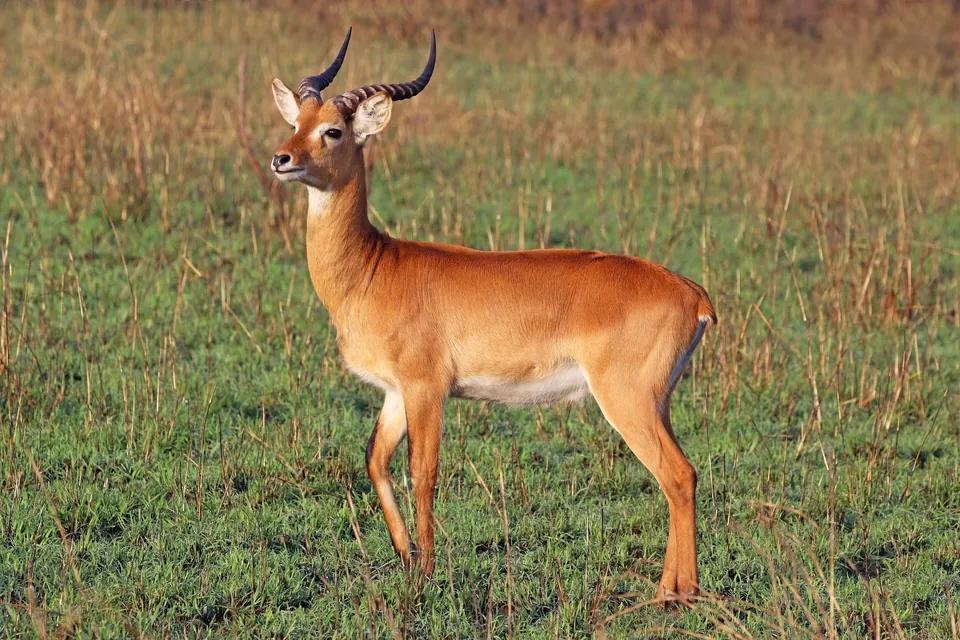
Look at Uganda’s coat of arms and you’ll see a grey crowned crane on one side of the shield and an antelope on the other. That antelope is the Uganda kob, and it’s the one you’ll see most on a game drive. The latest Uganda Wildlife Authority count puts it at about 175,000, the most numerous antelope in the country.
Name and classification
The Uganda kob is Kobus kob thomasi, first described scientifically in 1864. It’s one of three subspecies of the kob, Kobus kob, alongside Buffon’s kob of West Africa and the white-eared kob of South Sudan. Kob belong to the cattle and antelope family, Bovidae, in the same group as waterbuck and reedbuck.
The IUCN lists the Uganda kob as Least Concern. It shares the national coat of arms with the grey crowned crane, standing for the country’s wildlife.
Native origin
The Uganda kob is native to a fairly small part of Africa: Uganda, South Sudan west of the Nile, and north-eastern DR Congo. It used to live in western Kenya and north-western Tanzania too, but it has disappeared from both. Almost all of today’s Uganda kob live inside national parks and reserves, which makes Uganda’s protected areas the heart of its range.
Physical appearance
- Size: males stand about 90 to 100 cm at the shoulder and average around 94 kg. Females are smaller, at around 63 kg.
- Coat: golden to reddish-brown, with white on the throat, around the eyes, inside the ears, on the belly and inside the legs. The fronts of the forelegs are black.
- Horns: only males have them. They’re ridged and lyre-shaped, curving back and then up.
- Telling them apart: the kob is stockier than the impala, and lacks the waterbuck’s shaggy grey coat.
Habitat and diet
Kob like flat, open grassland and floodplains close to permanent water. They need to drink every day, so they rarely wander far into dry country. They graze on grasses and help keep short-grass areas short during the rains.
Because they’re so plentiful, kob feed most of Uganda’s big predators. Lions on the Kasenyi plains and in Ishasha rely on them, and leopards and hyenas take them too.
Behaviour and special abilities
- Leks: where kob are numerous, males gather on traditional breeding grounds called leks, each guarding a small patch of short grass. These grounds are used year after year.
- The middle matters: the most dominant males, often just three to seven of them, hold the central patches and get most of the matings.
- Short reigns: the competition is so fierce, and the need to eat and drink so strong, that a central male usually keeps his spot for only a day or two.
- Female groups: females and young move in loose herds and visit the lek to mate.
- Calves: born after about eight months and weaned at six to seven months.
Where to see Uganda kob
- Queen Elizabeth National Park: huge numbers on the Kasenyi plains, where you can often see a lek in action, and in Ishasha.
- Murchison Falls National Park: big herds on the Buligi tracks and the Delta north of the Nile.
- Toro-Semliki Wildlife Reserve: open plains near Lake Albert with good kob numbers.
- Kidepo Valley National Park: kob were reintroduced here in 2017.
On a game drive, ask your guide to stop near a lek. You’ll see males standing on worn, bare patches of ground, whistling, chasing off rivals and showing off to the females that wander through. Early morning on the Kasenyi plains is also the best time to find lions hunting kob, so one early start can give you both. For the other antelopes you’ll meet, see our guide to Uganda’s antelopes.
Found this useful? Send it to someone planning a trip.