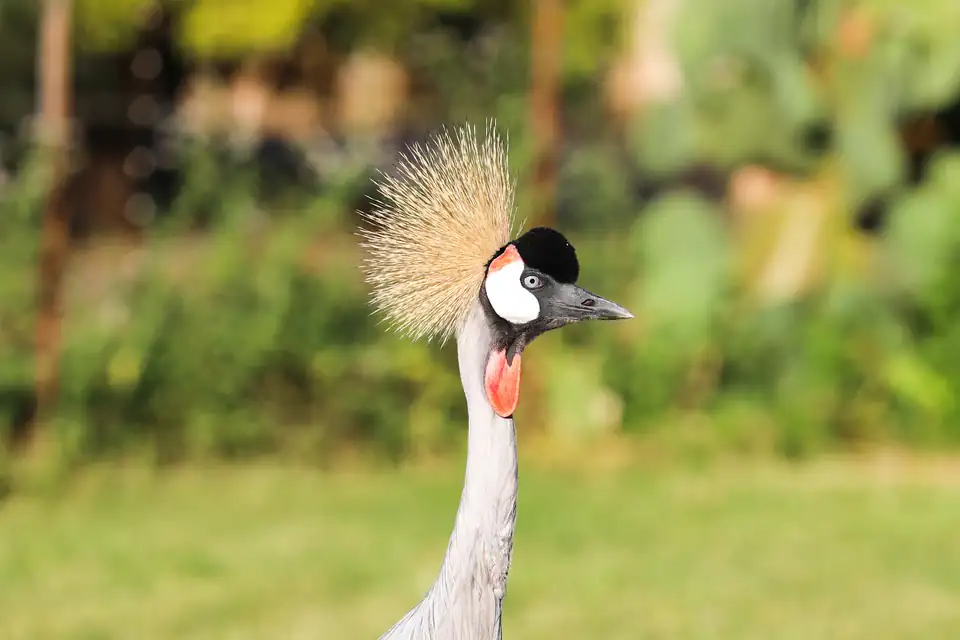

Look at Uganda’s flag and you’ll see it in the white circle at the centre: a grey crowned crane, known locally as the crested crane. It also stands on the national coat of arms. For many Ugandans, seeing one in the wild is a small moment of national pride.
A bird made for display
- Size: about a metre tall, with a wingspan of around two metres.
- The crown: a spray of stiff golden feathers on top of the head.
- The face: bright white cheeks, a black cap and a red, inflatable throat pouch.
- The body: mostly grey, with large white wing patches that flash in flight.
Cranes are famous for their dances, and this one is no exception. Pairs bow, leap into the air, spread their wings and call in a deep, honking duet. It’s part of courtship, but you can see it at other times too.
Unusually, grey crowned cranes can perch and roost in trees. They’re the only cranes that can, thanks to a long hind toe that grips branches. They eat a mix of seeds, grasses, insects, frogs and other small animals, often walking steadily through grassland and farmland, and they nest in wetlands.
A national symbol
The crested crane has been on Uganda’s flag since independence in 1962, standing on one leg inside the white disc between the black, yellow and red stripes. On the coat of arms it stands on one side of the shield, with a Uganda kob on the other. The national football team is even nicknamed “the Cranes”.
The bird’s elegance, its bright colours and its dancing have made it a natural emblem, and many Ugandans grew up seeing cranes feeding in the fields near home. That connection is one of the strongest tools conservationists have: people are proud of the bird and want it to survive.
Why it’s Endangered
In 2012 the IUCN moved the grey crowned crane from Vulnerable to Endangered after major declines. Recent global estimates are in the tens of thousands. The main pressures are:
- Wetland loss: swamps are drained for farming and settlement, removing nesting sites.
- Disturbance and conflict: birds feeding on crops are sometimes poisoned.
- Capture: cranes and eggs are taken for the illegal pet and ornamental bird trade.
- Power lines: a collision risk for a large bird flying between feeding and roosting areas.
The good news is that there is a lot of work under way. Organisations such as NatureUganda and the International Crane Foundation work with communities, especially in south-western Uganda, to restore wetlands and support livelihoods that don’t harm cranes, and Uganda has a species action plan for the bird.
Where to see it in Uganda
Much of Uganda’s crane population lives outside the parks, in small wetlands and farmland, so you may well see them from the road. Good places include:
- Lake Mburo National Park and the farmland and swamps around it.
- Queen Elizabeth National Park, especially on the open grasslands and near water.
- The valleys and wetlands of the south-west around Kabale and Lake Bunyonyi, on the way to or from gorilla trekking.
- Murchison Falls National Park and wetlands elsewhere in the country.
Practical tips
- Watch the wetland edges in the early morning and late afternoon.
- Listen for the call. The honking duet often gives away a pair before you see them.
- Never buy or photograph captive cranes for money. Paying for photos with tame birds can encourage their capture from the wild.
- Give nesting birds space. Cranes nesting in a swamp are easily disturbed.
Good to know
You don’t need to be a birder to enjoy this one. The crested crane is one of those birds that everyone on the vehicle wants to photograph, and it makes a great start to a conversation with your guide about Uganda’s wetlands.
Plan it with us
We can build crane-friendly stops into almost any route through the south-west, alongside Lake Mburo, Queen Elizabeth and your gorilla trek. Tell us what you’d love to see and we’ll plan it.
Found this useful? Send it to someone planning a trip.