Picture the last light of the day on a dirt track in northern Uganda. Something small and moth-like lifts off the ground in front of the vehicle, and behind it, two dark flags seem to chase it through the air. That’s a male standard-winged nightjar in breeding dress, and it’s one of the strangest sights in African birding.
A bird built for camouflage
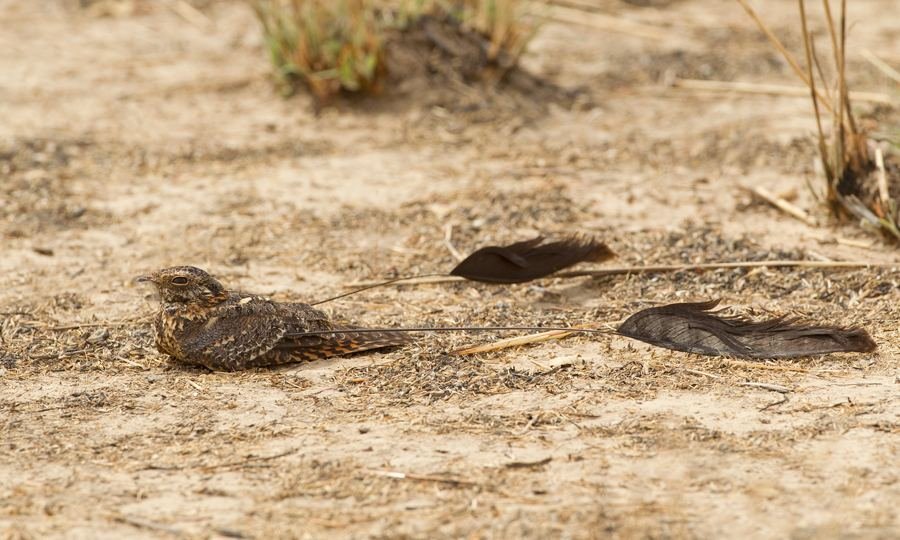
For most of the year, the standard-winged nightjar is simply a very well-disguised little bird. It is only about 20–23 cm long, with mottled grey, brown and buff plumage that matches leaf litter and bare earth almost perfectly. Like other nightjars, it rests on the ground by day, often with its eyes half closed, and relies on keeping still rather than flying away. It feeds after dark on flying insects such as moths and beetles, caught on the wing.
It doesn’t even build a nest. The female lays her eggs straight onto bare ground, trusting camouflage to keep them safe.
The male’s “standards”
In the breeding season, the male grows one extraordinary feather on each wing. Most of it is a long, bare shaft, and only the tip carries a broad vane, like a small flag on a pole. Field guides give the whole feather at around 38 cm, which is much longer than the bird itself.
- In normal flight the standards trail behind, giving the odd impression of a bird being followed by two smaller ones.
- During display, males raise them over their backs as they fly low over open, bare patches of ground where several males may gather.
- They are a seasonal accessory. After breeding, the males lose them and look like any other nightjar again.
The name comes from those flags: a “standard” is a banner carried on a pole.
Where to see it in Uganda
The species lives in dry, lightly wooded savanna across a belt of Africa from Senegal to Ethiopia, and Uganda sits at the southern edge of that range. Here it’s a bird of the drier north and north-west.
- Murchison Falls National Park is the most reliable place we know. Birding guides regularly look for it on the tracks at dusk, including the road towards the top of the falls.
- Other areas of northern savanna can hold it too, and local guides keep track of recent sightings. We’ll check the latest reports when we plan your route.
When to go
The breeding season, and therefore the time when males carry their standards, depends on rainfall and insect numbers, and it varies across the species’ range. Uganda birding guides generally recommend roughly September to April, with the drier months giving the best chance of displaying males. Outside that window you may still find the bird, but the males won’t have their famous flags.
Practical tips
- Be out at dusk. The best viewing is in the half hour or so after sunset, when the birds become active. Park rules on driving after dark apply, so we’ll plan timings with your guide and lodge.
- Watch the road ahead. Nightjars often sit on tracks and flush in the headlights.
- Use a torch carefully. A brief beam is enough for a look. Don’t dazzle the bird or chase it.
- Pack for evenings. Long sleeves and insect repellent make dusk sessions far more pleasant. See our East Africa packing list.
- Stay nearby. Lodges close to the river, such as Paraa Safari Lodge or Pakuba Safari Lodge, make an evening outing easy.
Good to know
The standard-winged nightjar is listed as Least Concern, so it isn’t rare across its range. What makes it special is how hard it is to see well, and how brief the season of the male’s plumes is. A sighting is never guaranteed, but when it happens it tends to be the moment people talk about at dinner.
Plan it with us
If the nightjar is on your list, tell us when you’re travelling and we’ll build a Murchison Falls stay around the best evenings, together with the river launch, game drives and, if you like, chimpanzee tracking in Budongo. For more ideas, see our guide to the top birding spots in Uganda.
Found this useful? Send it to someone planning a trip.