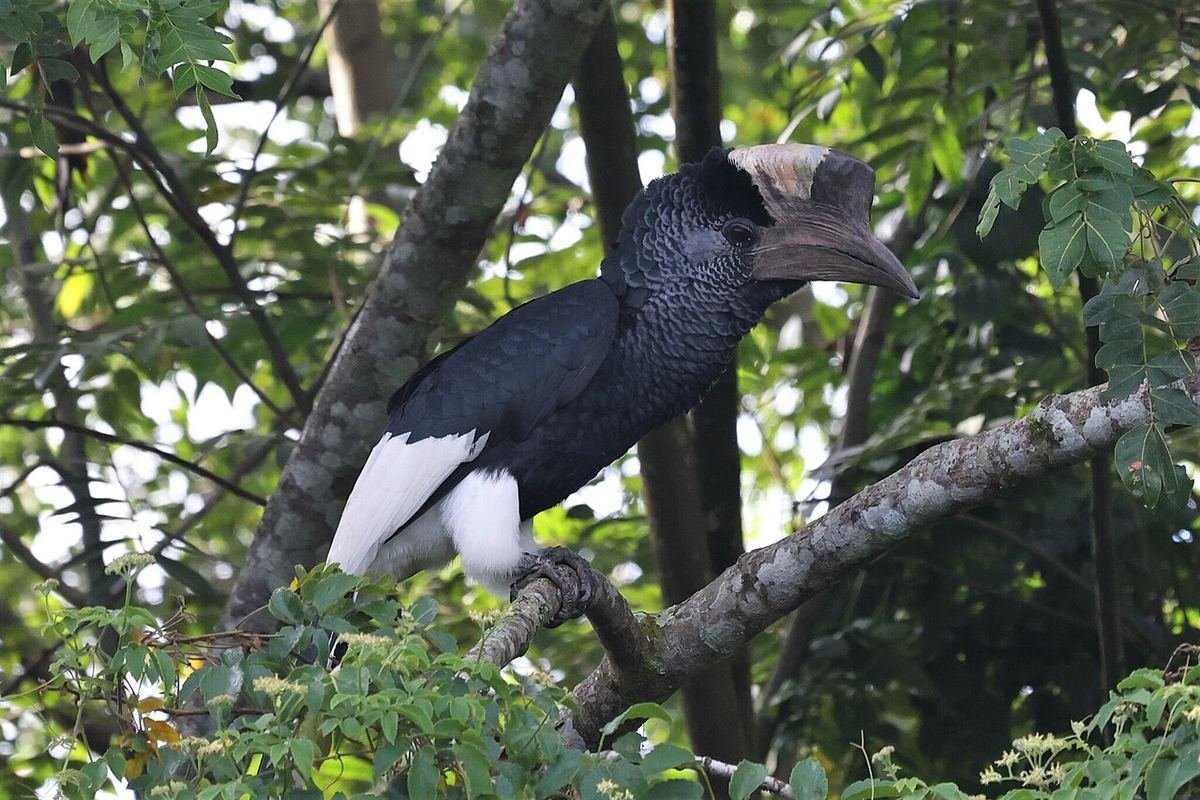
Walk into almost any lowland forest in Uganda and sooner or later you’ll hear a loud “whooshing” overhead, like someone beating a heavy blanket. Look up and you’ll probably see a pair of black-and-white-casqued hornbills crossing a gap in the canopy. They’re among the most conspicuous birds in the country’s forests, and among the most important.
How to recognise one
- Size: a big bird, around 60–70 cm long, with a wingspan that can approach a metre.
- Colours: mostly black, with white on the lower body, a broad white patch in the wings that flashes in flight, and a lot of white in the tail.
- The casque: the helmet-like structure on top of the bill is large and pale on top. Males have a bigger casque than females, which is the easiest way to tell a pair apart.
Calls and that famous wing noise
These hornbills are noisy. Their calls are loud, nasal brays and wails that carry a long way through the forest, and pairs often call back and forth. Just as distinctive is the sound of their wings. It’s so loud that experienced guides can tell you a hornbill is flying over without looking up. Once you know the sound, you’ll notice it everywhere.
Why the forest needs them
These hornbills eat mainly fruit, with figs a particular favourite, and add the odd lizard, insect or egg. Because they swallow fruit whole and travel widely between feeding trees, they carry seeds well away from the parent tree before dropping them. That makes them important seed dispersers, especially for trees with larger fruits that smaller birds can’t manage. Where hornbills disappear, the make-up of a forest can slowly change.
Their nesting is remarkable too. They nest in natural tree cavities, and, as with many hornbills, the female seals herself inside with mud and droppings, leaving only a narrow slit. The male then feeds her, and later the chicks, through the gap. It’s one reason they need forests with big, old trees.
Where to see them in Uganda
The species is widespread in the forests of central Africa and is listed as Least Concern. In Uganda, good places include:
- Kibale National Park, where you’ll often hear them during chimpanzee tracking, and neighbouring Bigodi Wetland Sanctuary.
- Mabira Forest, an easy stop on the road between Kampala and Jinja.
- Semuliki National Park, which also has several other hornbill species more typical of the Congo Basin.
- Budongo Forest near Murchison Falls, and the lower-lying parts of Bwindi.
- Even the big trees around Entebbe, which makes them a nice first bird for many visitors.
Other hornbills to look for in Uganda
Once you’ve met this one, you’ll start noticing its relatives. Uganda has a good range of hornbills, from forest giants to savanna walkers:
- Piping and white-thighed hornbills — forest species of the west, with Semuliki the best place to compare them.
- Crowned and African grey hornbills — smaller birds of woodland and savanna edges.
- Abyssinian ground hornbill — a huge, mostly black bird that walks through the grass of the northern parks such as Murchison Falls and Kidepo.
The black-and-white-casqued hornbill is the one you’re most likely to meet on a forest walk, and the pale casque, white wing patch and loud wingbeats are the features to remember.
Practical tips
- Look for fruiting trees. A fig in fruit can attract hornbills, turacos and monkeys all at once.
- Go early. Mornings are the most active time, and the light is kinder for photos.
- Listen first. Follow the wing noise and the calls, then scan the canopy edges.
- Bring binoculars. Birds in the canopy can be high up. 8x42 or 10x42 are ideal in forest.
Good to know
You don’t need a special birding trip to see this hornbill. It’s a regular companion on primate walks, so if you’re joining us for chimpanzee tracking in Kibale, ask your guide to point them out.
Plan it with us
Whether you’re a keen birder or simply curious about the forest around you, we can build in time with a specialist bird guide in Kibale, Mabira or Semuliki. Tell us your dates and interests and we’ll suggest a route.
Found this useful? Send it to someone planning a trip.