The Uganda Wildlife Authority’s latest count puts the country’s lions at 291. That’s fewer people than you’d find at a busy Kampala wedding. They live in some of Uganda’s loveliest savanna, and seeing them now, with a careful guide, helps pay for their protection.
Name and classification
The lion is Panthera leo, a member of the cat family, Felidae. It shares the genus Panthera with the tiger, leopard, jaguar and snow leopard. In Luganda it’s empologoma. Since 2017 cat specialists have recognised two subspecies: Panthera leo leo in West and Central Africa and India, and Panthera leo melanochaita, which covers most lions in East and southern Africa.
The IUCN lists the lion as Vulnerable worldwide. On Uganda’s own national Red List it is Critically Endangered.
Native origin
Lions are African animals at heart. They once also lived across North Africa, the Middle East and into India. Today wild lions survive across much of sub-Saharan Africa and in one corner of Asia, the Gir forest of Gujarat in India, home to the last Asiatic lions.
In Uganda, lions now live in only three parks: Murchison Falls, Queen Elizabeth and Kidepo Valley. Lake Mburo, the closest savanna park to Kampala, no longer has resident lions.
Physical appearance
- Size: adult males usually weigh around 150 to 250 kg. Females are smaller and lighter.
- The mane: only males grow one. It tends to darken and thicken with age and good health.
- Tail tuft: the lion is the only cat with a dark tuft at the end of its tail.
- Cubs: they’re born with faint spots, which fade as they grow. Some adults keep a trace of them on the legs and belly.
Habitat and diet
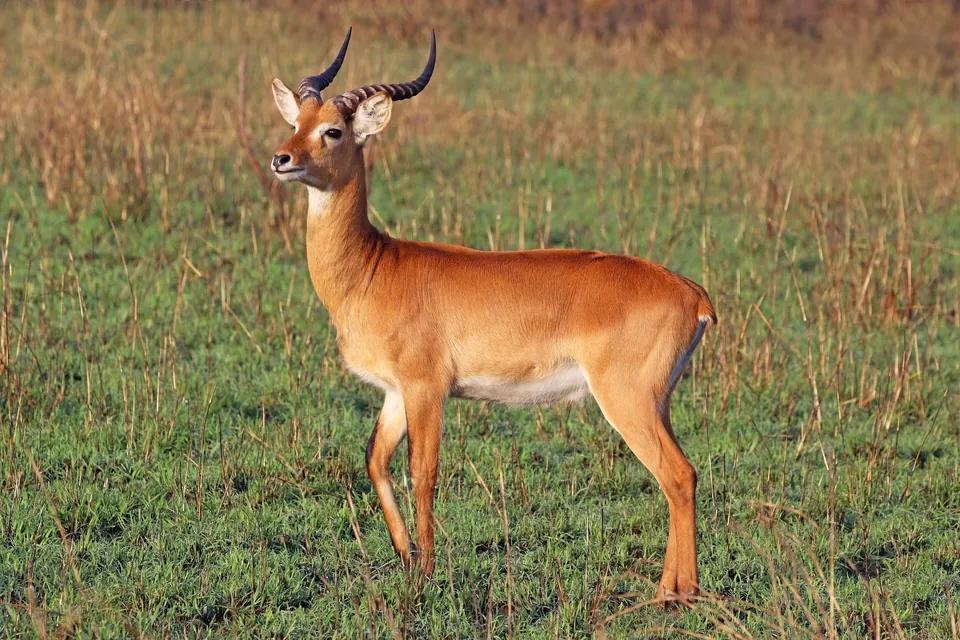
Lions like open grassland and light woodland with plenty of prey and some water. In Uganda their main meal is the Uganda kob, which gathers in big herds on the Kasenyi plains and in Murchison. They also take warthog, waterbuck, topi and buffalo, which need a whole pride working together.
The females do most of the hunting. Males are more likely to defend the territory and the pride, though they hunt too, especially big prey like buffalo.
Behaviour and special abilities
- The social cat: lions are the only cats that live in prides, family groups of related females, their cubs and one or more males.
- The roar: it can carry for several kilometres, telling other lions whose ground this is.
- Long rests: lions can sleep or doze for up to 20 hours a day, so a midday lion is usually a flat one.
- Tree climbing: in the Ishasha sector of Queen Elizabeth, lions often rest in big fig trees. Read about the tree-climbing lions of Ishasha.
How Uganda’s lions are doing
UWA’s State of Wildlife Resources 2026 report gives 291 lions in the monitored parks, down from 314 in the previous count. The picture differs a lot from park to park:
- Murchison Falls is the stronghold. A 2024 study estimated about 240 lions in the area it surveyed.
- Queen Elizabeth has had a hard decade. Detailed monitoring identified 93 lions in 22 prides in 2025, which UWA puts down to better counting rather than a sudden recovery.
- Kidepo Valley is the worry. About 132 lions were estimated in 2009, and only around 12 in a 2022 survey.
The main threat is poisoning after lions kill cattle. Eleven lions died this way in Queen Elizabeth in 2018, and four more in December 2025. Snares and the illegal trade in body parts add to it. Uganda now has a ten-year action plan for large carnivores (2024–2034), and much of the work happens with herders on the park edges, through stronger livestock enclosures and a share of tourism money.
Where to see lions in Uganda
- Murchison Falls National Park: your best odds. Go out early on the Buligi tracks and the Delta area north of the Nile.
- Queen Elizabeth National Park: the Kasenyi plains at dawn, and Ishasha in the south. You can also join researchers on a lion tracking experience.
- Kidepo Valley National Park: lions are few, so treat a sighting in the Narus Valley as a real bonus.
- UWEC, Entebbe: rescued lions you can see up close on your first or last day.
Lions are most active at dawn, so plan early starts. Good guides don’t crowd them or drive off-road where it isn’t allowed. If big cats are your top priority, Uganda pairs well with the Serengeti or the Maasai Mara; see our Mara vs Serengeti guide. Tell us your dates and we’ll plan a route around the best lion country.
Found this useful? Send it to someone planning a trip.