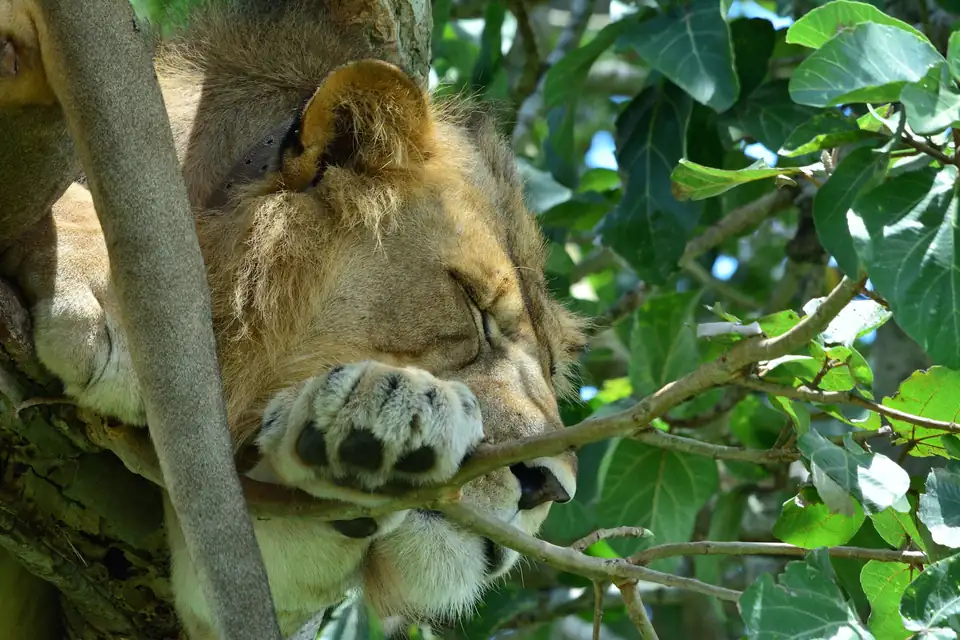

A fully grown lion weighs as much as two or three grown men, and most of them would rather lie in the shade on the ground. In the Ishasha sector of Queen Elizabeth National Park, though, lions regularly haul themselves into big fig trees and sprawl along the branches with their legs hanging down. Here’s what we know about them.
Name and classification
These are ordinary lions, Panthera leo, the same species you’ll find in Murchison or the Maasai Mara. “Tree-climbing lion” is a description of a habit, not a separate subspecies or a different animal. Like other lions in East Africa, they belong to the subspecies Panthera leo melanochaita. The IUCN lists lions as Vulnerable, and Uganda’s national Red List treats them as Critically Endangered.
Native origin
Ishasha is the remote southern part of Queen Elizabeth, on the border with the Democratic Republic of Congo. The Ishasha River marks the frontier, and across it lies Congo’s Virunga National Park, so lions here are part of a wider cross-border landscape. The tree habit isn’t unique to Uganda. Lions in Tanzania’s Lake Manyara and a few other places climb too, but Ishasha is where you’re most likely to see it.
Physical appearance
Ishasha’s lions look like other lions: tawny coats, a tufted tail, and manes on the males, which here are often quite dark. What surprises people is how clumsy the climb looks. A lion isn’t built like a leopard. It scrambles up a sloping trunk using its strong forelegs and claws, then picks a thick branch to lie on. Coming down is usually a slide or a heavy jump. They choose trees with wide, low, spreading branches, which is why you’ll see them in the same favourite figs again and again.
Habitat and diet
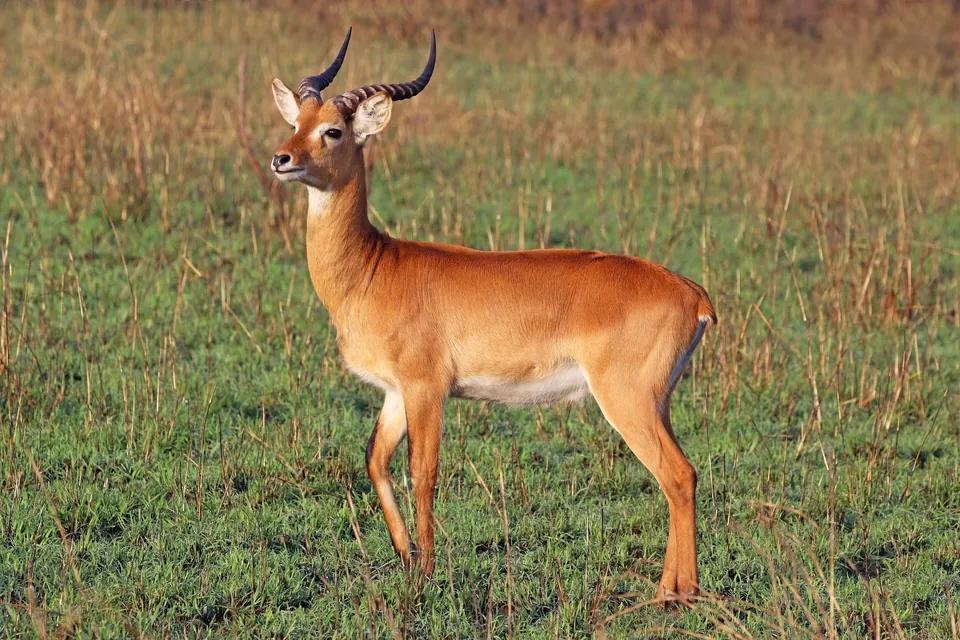
Ishasha is open grassland dotted with large fig trees and acacias, with riverine forest along the water. The plains hold big herds of Uganda kob and some of the park’s best numbers of topi, and these are the lions’ main prey. Buffalo are common too, and elephants pass through. Lions usually hunt in the cool of early morning, late evening or at night, then climb to rest through the hot middle of the day.
Behaviour and special abilities
Nobody knows for certain why these lions climb, and it’s probably a mix of reasons:
- Keeping cool: a few metres up there’s more breeze and less heat coming off the ground.
- Escaping flies: branches may give some relief from biting insects in the grass.
- A lookout: from a tree, a lion can watch the kob and topi on the plains.
- Learned habit: cubs grow up watching adults climb, so the behaviour passes down the generations.
Their numbers are small and precious. Six lions were found dead in Ishasha in 2021 with body parts removed, and Queen Elizabeth lost four more to poisoning in December 2025. UWA and researchers now follow the prides closely, and a lion in a tree is never guaranteed. Read more in our post on the lions of Uganda.
Where to see the tree-climbing lions in Uganda
- Time of day: late morning to mid-afternoon, when it’s hottest and lions head up into the trees. Early mornings are better for seeing them on the move.
- Season: lions climb all year, but the drier months, roughly December to February and June to September, make the black-cotton soil tracks much easier. They get very muddy in the rains.
- Give it time: a full afternoon, or a night in Ishasha, gives far better odds than a quick drive through.
- Getting there: Ishasha sits on the natural route between northern Queen Elizabeth (Mweya, Kasenyi and the Kazinga Channel) and the Buhoma sector of Bwindi Impenetrable National Park, passing the Kigezi Wildlife Reserve. Many guests do a game drive here on the way to their gorilla trek.
- Where to stay: Ishasha Wilderness Camp is a comfortable tented camp by the Ntungwe River. Others stay in the north of the park or near Buhoma and visit on a long day.
Stay in the vehicle, never park right under a tree with lions in it, and keep your voice down. A 200–400 mm lens helps, because a lion in leaves is hard to pick out on a phone. More tips in our safari photography guide. We’ll fit Ishasha into your Queen Elizabeth and Bwindi route with a guide who knows the favourite trees.
Found this useful? Send it to someone planning a trip.