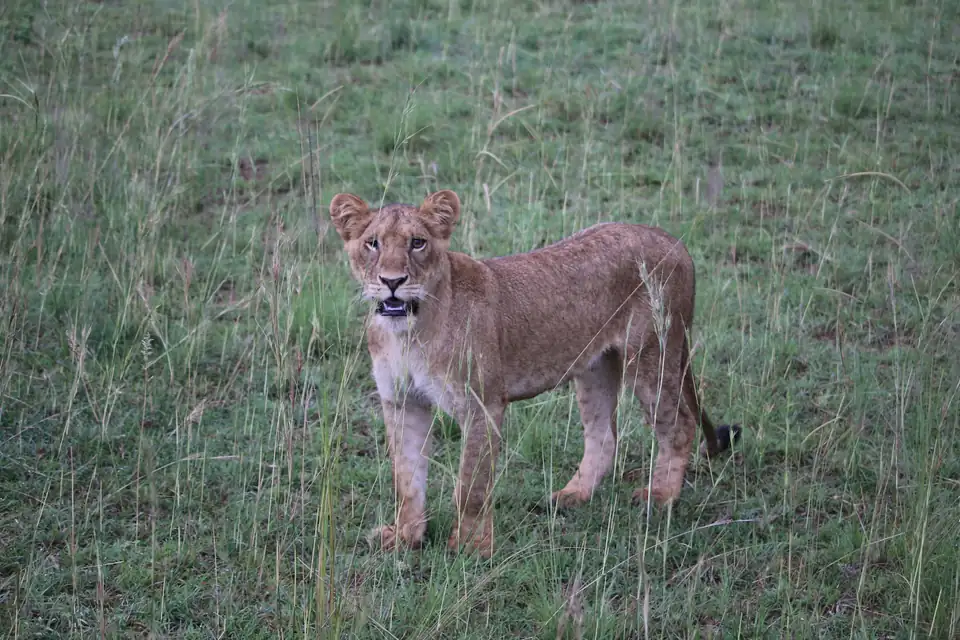

A normal game drive shows you lions. Experiential lion tracking in Queen Elizabeth National Park shows you how they’re studied and protected. You head out with the team that monitors the park’s lions, use radio telemetry to find a collared pride, and spend time watching and learning while the researchers work. It’s one of the most rewarding ways to spend a morning in Uganda.
How it works
Some of the park’s lions, usually lionesses, wear radio collars. They’re fitted by the research team working with the Uganda Wildlife Authority (UWA), including the Uganda Carnivore Program, and allow the pride to be located and monitored. On the activity you’ll:
- meet the researchers and get a briefing on the lions and the threats they face;
- drive out onto the plains, mainly around Kasenyi in the north of the park;
- use a telemetry receiver and antenna to pick up the collar’s signal, which gets stronger as you get closer;
- spend time with the lions once they’re found, while the team records behaviour, condition and location.
Sessions usually last two to three hours and start early, when lions are most active. Group sizes are kept small so the lions aren’t disturbed. Because it’s a research activity, the vehicle may be allowed to leave the main tracks under the researchers’ direction, which normal game drives can’t do.
A typical morning
Expect a pre-dawn wake-up call and a quick coffee before you meet the team. As the sky lightens over the Kasenyi plains, the researcher sweeps the antenna from side to side, listening for the faint beep of a collar. Once the signal is strong, the vehicle moves in slowly and the engine is switched off. Then it’s time to watch: a pride waking up, cubs playing, or lionesses eyeing a herd of Uganda kob. While you watch, the researchers note which lions are present, their condition and what they’re doing, and they’re happy to answer questions. Most guests are back at the lodge by late morning, with plenty of time for a Kazinga Channel boat trip in the afternoon.
What it costs
The UWA tariff lists experiential lion tracking in Queen Elizabeth at US$200 per person for foreign non-residents, US$150 for foreign residents and UGX 200,000 for East African citizens. This excludes a US$10 community fee and a vehicle fee, and park entry is extra.
UWA has announced that from 1 January 2027 the price rises to US$500 for foreign non-residents, US$300 for foreign residents and visitors from the rest of Africa, and UGX 250,000 for East African citizens. If you’re travelling in late 2026, booking now saves a lot. As always, we’ll confirm the current fee when we book.
Why it matters
Queen Elizabeth’s lions have had a hard decade. UWA’s 2026 wildlife report records a steep decline in the park, driven mainly by poisoning linked to livestock losses and trade in body parts. Monitoring with individual identification found 93 lions in 22 prides in 2025, giving managers a much clearer picture. Your fee helps fund that monitoring, and the researchers’ time with you builds support for lions well beyond the park. For the wider story, read our post on the lions of Uganda.
Other research experiences in the park
- Mongoose tracking: join researchers following banded mongoose groups on the Mweya Peninsula. UWA lists it at US$30 for foreign non-residents.
- Hippo census: help count hippos along the Kazinga Channel, listed at US$100.
Both need booking in advance. And don’t miss the tree-climbing lions of Ishasha in the south of the park.
Good to know
- Book early. Places are very limited each day, and it can’t be arranged on the spot.
- Sightings are likely, not guaranteed. The collars help, but lions move and the team decides how close it’s appropriate to go.
- Follow the researchers. Stay seated, keep quiet near the lions, and don’t ask to get closer than they allow.
- Where to stay: lodges near Kasenyi and Mweya, such as Mweya Safari Lodge, Katara Lodge or Simba Safari Camp, make the early start easy.
- Bring: binoculars, a camera with a zoom lens, a warm layer for the early start and a hat for later.
Plan it with us
We’ll secure your lion tracking slot, arrange the right lodge and fit it around a Kazinga Channel boat trip, chimps in Kyambura Gorge or Kibale, and gorillas in Bwindi. See our wildlife safaris or get in touch for a tailor-made plan.
Found this useful? Send it to someone planning a trip.