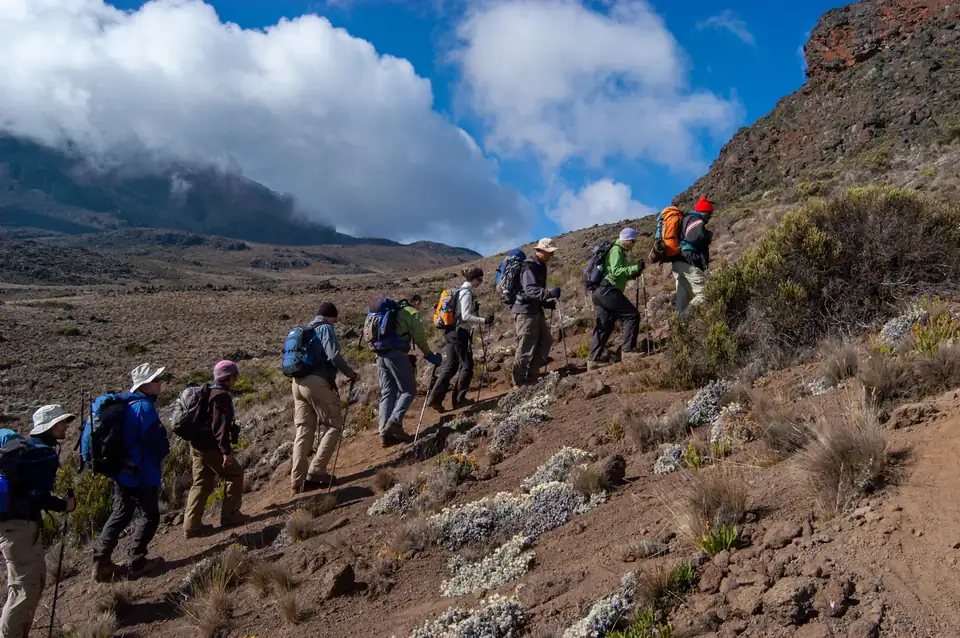

At 5,895 metres, Kilimanjaro is Africa’s highest mountain and the world’s tallest free-standing peak. You don’t need ropes or climbing experience to reach the top, which is why tens of thousands of people attempt it every year. But “non-technical” doesn’t mean easy. The real challenge is altitude, and the route and number of days you choose make the biggest difference to how you feel on summit night.
The main routes
- Marangu (5–6 days): the only route with hut accommodation, sleeping in shared huts rather than tents. The gradient is gentle, but it’s often done in five days, which gives little time to acclimatise. We recommend the six-day version.
- Machame (6–7 days): a very popular camping route through rainforest and across the Shira Plateau. It follows a “climb high, sleep low” profile via the Lava Tower, which helps acclimatisation. Busier than most.
- Lemosho (7–8 days): starts on the remote western side, joins the Machame trail later, and has an excellent acclimatisation profile. Our favourite all-rounder for scenery and success.
- Rongai (6–7 days): approaches from the north, near the Kenyan border. Drier and quieter, with a steady climb, though less varied scenery. A good choice in the wetter months.
- Northern Circuit (8–9 days): the newest and longest route, circling round the quiet northern slopes. The extra days make it one of the best for acclimatisation, and you’ll see very few other groups.
- Umbwe (6–7 days): the shortest and steepest approach. Physically demanding and quick to gain height, so we only suggest it for fit trekkers with previous high-altitude experience.
Most routes (except Marangu) descend via the Mweka trail. On summit night you’ll reach the crater rim at either Gilman’s Point (5,681 m) or Stella Point, then continue along the rim to Uhuru Peak.
How many days do you need?
As many as you can give it. The park authority doesn’t publish official route-by-route summit figures, and the percentages quoted online vary widely, so treat any precise number with caution. What is consistent is that shorter itineraries have lower success rates, because the body simply hasn’t had time to adapt. For most people, seven or eight days is the sweet spot. An extra day costs less than a failed summit.
Altitude: what to expect and how to stay safe
Acute mountain sickness (AMS) is common on Kilimanjaro, even among very fit people. Symptoms include headache, nausea, loss of appetite, poor sleep and fatigue. In rare cases it can progress to high-altitude pulmonary or cerebral oedema (HAPE or HACE), which are life-threatening. The single biggest risk factor is climbing too fast.
- Go slowly. You’ll hear “pole pole” (slowly, slowly) from your guides constantly. Take it seriously.
- Drink plenty of water and keep eating, even when you’re not hungry.
- Be honest with your guide. Good guides check your oxygen levels and symptoms daily. Report headaches and nausea early.
- Descend if symptoms get worse. Descent is the most effective treatment. No summit is worth your health.
- Talk to your doctor before you travel about altitude medication and any existing conditions.
- Check your insurance covers trekking to at least 6,000 metres, including emergency evacuation.
When to climb
The driest and most popular months are roughly January to early March and June to October. The long rains, usually April and May, make trails muddy and views cloudy, and the short rains fall around November. You can climb year-round, but the dry months give the best chance of clear summit views.
Park fees
Kilimanjaro National Park charges several fees on every climb, including a daily conservation fee, camping or hut fees for each night, and a one-off rescue fee, with VAT added on top. They’re a large part of the cost of any climb, and a longer route means more park days. Rates are reviewed by TANAPA, so we’ll confirm current fees and include them all in your quote.
Practical tips
- Train with long hill walks carrying a daypack for several months before you go.
- Summit night is bitterly cold. Pack proper down, warm gloves, a hat and spare head-torch batteries.
- Choose an operator that treats its porters fairly, with proper wages, loads, clothing and food. Ask us how our crews are looked after.
- Most climbs start from Moshi, at the foot of the mountain. Spend a night there before you start.
Find out more on our Kilimanjaro National Park page and our mountaineering experiences. Tell us your fitness, dates and budget, and we’ll recommend the route and length that give you the best chance of standing on the Roof of Africa.
Found this useful? Send it to someone planning a trip.