
You can drive right past a leopard and never know it was there. It’s solitary, it’s mostly active at night, and its spotted coat disappears in dappled shade. That’s why guides get so excited when they find one, and why a good sighting is worth the early starts.
Name and classification
The leopard is Panthera pardus, one of the big cats in the genus Panthera. Africa’s leopards belong to the subspecies Panthera pardus pardus. In Luganda the leopard is engo. The IUCN lists the species as Vulnerable.
A “black panther” isn’t a separate animal. It’s a leopard (or a jaguar in the Americas) with a dark coat, and the spots are still there if you look closely.
Native origin
Leopards have the widest range of any wild cat. They’re native to much of sub-Saharan Africa and to parts of Asia, from the Middle East and India to China and the Russian Far East, though many Asian populations are now small and scattered.
In Uganda they turn up in savanna parks and forests alike. The Uganda Wildlife Authority’s 2026 report quotes a recent estimate of around 328 leopards in the country, far fewer than in past decades.
Physical appearance
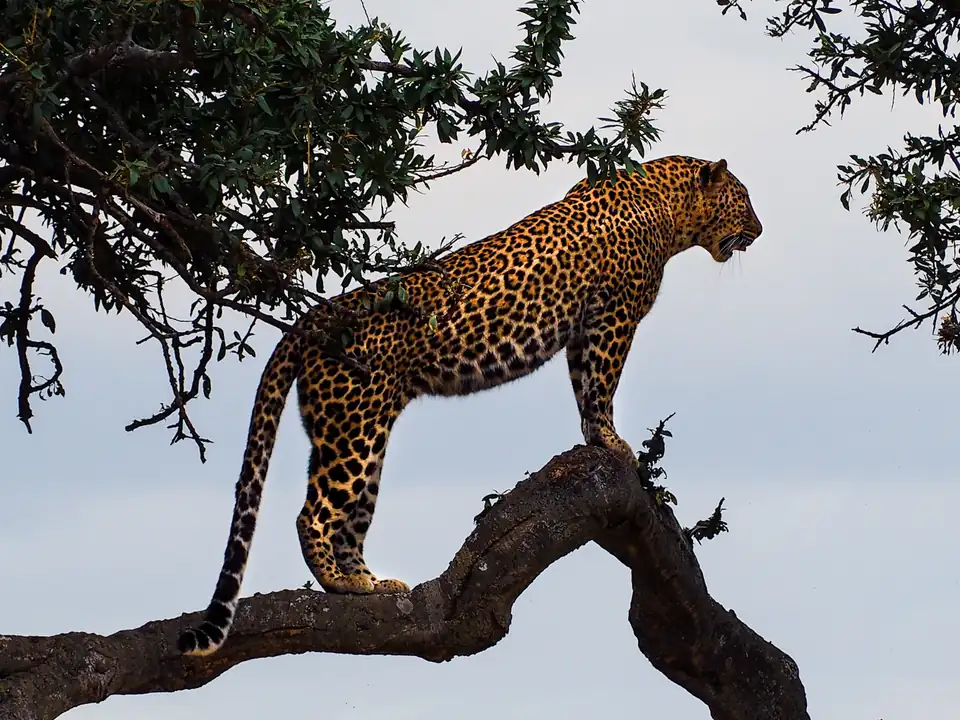
- Coat: golden to pale yellow, covered in rosettes, rings of dark spots around a lighter centre. Every leopard’s pattern is different.
- Size: males are much bigger than females, averaging around 58 kg against about 37 kg.
- Build: short legs, a long body and a thick neck and shoulders. A powerful climber rather than a long-distance runner.
- Tail: long, with a white tip underneath that cubs can follow in long grass.
Habitat and diet
Leopards can live almost anywhere with cover and food: rainforest, riverine thickets, rocky hills, savanna and mountains. That’s a big part of their success.
Their diet is just as flexible. They eat small antelopes such as bushbuck and kob, monkeys and baboons, warthogs, hares, birds and even fish. They hunt mainly by stalking close and pouncing, usually between sunset and sunrise.
Behaviour and special abilities
- Tree larders: a leopard can haul a carcass heavier than itself up a tree, where lions and hyenas can’t reach it. A kill in a tree is often the first clue a leopard is around.
- Loners: adults live alone and hold territories. Males and females meet to mate, and mothers raise cubs on their own.
- The call: a rasping cough, often compared to someone sawing wood.
- Swimmers: unlike many cats, leopards will cross water if they need to.
The main threats in Uganda are snares, retaliation after livestock losses, habitat loss and a shrinking prey base.
Where to see leopards in Uganda
- Murchison Falls National Park: a camera-trap survey published in 2024 found about 14 leopards per 100 km² on the northern bank, among the highest densities recorded in Africa. Look in the riverine woodland and on the Buligi tracks.
- Lake Mburo National Park: with no resident lions, the leopard is the top cat here, and ranger-led night drives give you a real chance.
- Queen Elizabeth National Park: seen around Mweya, Kasenyi and Ishasha, often in thickets near the Kazinga Channel.
- Kidepo Valley National Park: the rocky outcrops of the Narus Valley are classic leopard country.
UWA offers guided night drives in several savanna parks, usually for guests staying inside the park, so where you sleep matters. Our night drives page explains how they work. Scan big trees for a hanging tail, listen for monkeys and baboons giving alarm calls, and give it two or three nights in one good park. In Tanzania and Kenya, the Serengeti’s Seronera valley and the Maasai Mara are famous for leopards too. Ask us and we’ll time your stay for at least one dawn and one after-dark outing in leopard country.
Found this useful? Send it to someone planning a trip.