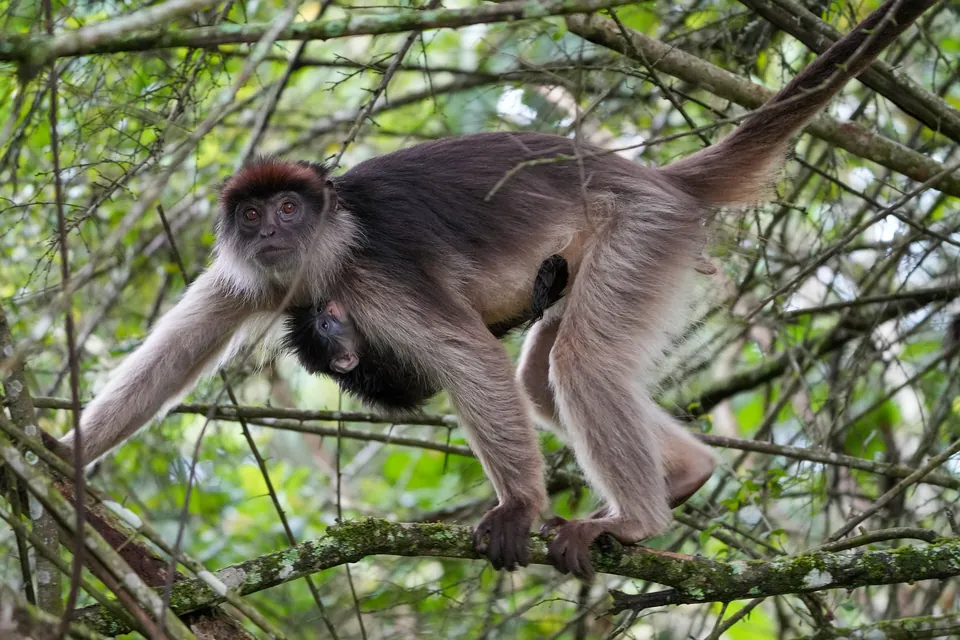
On a chimp trek in Kibale, the guides keep one ear on the red colobus. When a troop suddenly starts shrieking and the males crowd together, chimps may be close and hunting. These rusty-capped monkeys are one of the most common primates in Kibale, yet they’re rare almost everywhere else.
Name and classification
- Common names: Ugandan red colobus, ashy red colobus.
- Latin name: Piliocolobus tephrosceles. Some authorities place it in Procolobus, or treat it as a subspecies, Procolobus rufomitratus tephrosceles. Over the years it’s also been lumped with other red colobus species. The name you see depends on the book.
- Family: Cercopithecidae, in the colobine group with the black-and-white colobus.
- IUCN status: Endangered.
Native origin
This species lives only in western Uganda and western Tanzania, in a handful of forest blocks spread over about 1,000 km. In Tanzania it’s known from places such as Gombe and the Mahale area. It may also occur in Rwanda, Burundi and eastern DR Congo, but that hasn’t been confirmed. Uganda holds by far the largest population, estimated at around 17,000, and most of those live in Kibale National Park. Scientists see the Kibale population as the species’ best hope.
Physical appearance
Look for a rust-red cap on top of the head and a dark grey to black face. The back varies from black to reddish brown, the sides and limbs are grey to black, and the long tail is brown. Infants are born with fully black faces. Males are much bigger than females, averaging about 10.5 kg against about 7 kg. Like the guereza, the red colobus has only a tiny stub of a thumb. There’s no white mantle or white tail, which is the quickest way to tell the two colobus monkeys apart.
Habitat and diet
It’s a monkey of tall, moist evergreen forest, and it spends almost all its time in the canopy. Leaves are the main food, with a clear preference for young leaves and leaf stalks. It also takes some bark, seeds and fruit. Like other colobus monkeys it has a large, chambered stomach that ferments tough plant food. Logging hurts it badly, which is one reason Kibale’s protection since the early 1990s has mattered so much.
Behaviour and special abilities
- Big groups: troops have several adult males and range from 3 to 85 animals, about 40 on average. Females outnumber males.
- Split and rejoin: large groups often break into smaller foraging parties when food is short, then come back together.
- Females move on: unusually for monkeys, it’s mostly females that leave their birth group, while males tend to stay.
- Mixed company: red colobus often travel with red-tailed monkeys, and sometimes with mangabeys and blue monkeys. More eyes means earlier warning of eagles and chimps.
- Standing their ground: chimpanzees are their main predator, with crowned eagles next. At Ngogo in Kibale, chimps have at times killed a large share of the local red colobus in a single year. Red colobus males often fight back as a group, mobbing and chasing the hunters.
Where to see red colobus in Uganda
Kibale is the place. You’ll probably meet them on a chimp trek, and the community walk at Bigodi Wetland Sanctuary is also good for them; see our Bigodi walk guide. Read more about the chimpanzees that hunt them and the black-and-white colobus, or see the full primates of Uganda list.
Once you know the sound they’re easy to find. Listen for squeaks, chatters and the crash of branches as a big troop moves through the tall trees. Bring binoculars, because they tend to stay high in the canopy.
Found this useful? Send it to someone planning a trip.