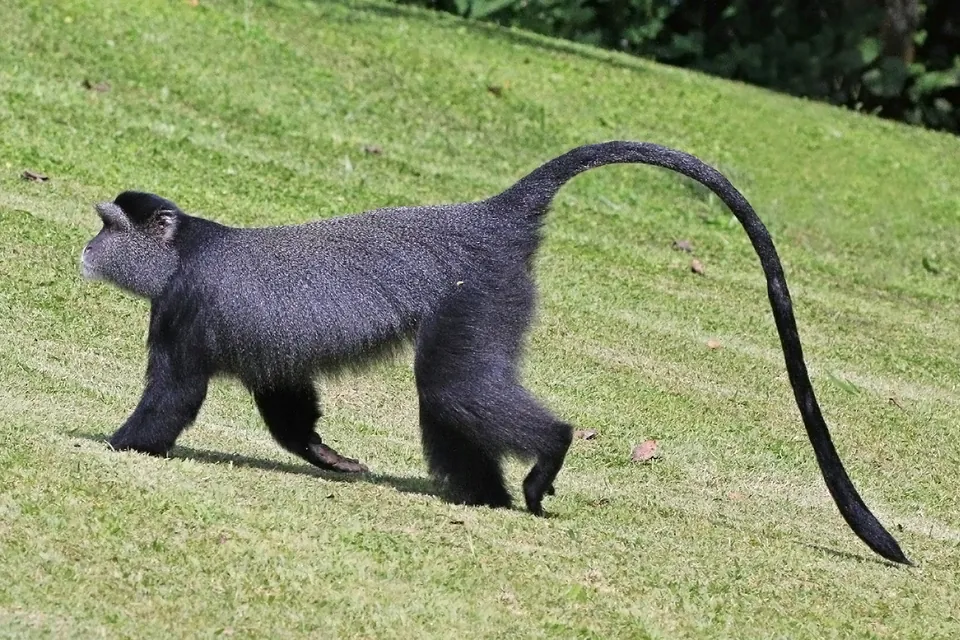
Visitors often ask why it’s called a blue monkey when it looks grey. Fair question. In soft forest light the fur on its shoulders can take on a slaty, bluish sheen, and that’s where the name came from. Up close it’s mostly grey and olive, with a dark face and a pale band across the brow.
Name and classification
- Common names: blue monkey, diademed monkey. Some races go by other names, such as Sykes’ monkey in Kenya and Tanzania and the golden monkey of the Virungas.
- Latin name: Cercopithecus mitis. Much of Uganda’s population is Stuhlmann’s blue monkey, C. m. stuhlmanni. The golden monkey of Mgahinga, C. m. kandti, is usually treated as another race of the same species.
- Family: Cercopithecidae, one of the guenons.
- IUCN status: Least Concern as a species, although some races, including the golden monkey, are threatened.
Native origin
Blue monkeys have one of the biggest ranges of any African forest monkey, from the upper Congo Basin east to the Rift Valley and south through Angola and Zambia, with related forms reaching down to South Africa. In Uganda they’re found in the main western forests, such as Kibale, Budongo, Bwindi, Kalinzu and Semuliki, and on Mount Elgon in the east.
Physical appearance
It’s a medium-sized, solid-looking guenon. The body is about 50–65 cm long, with a tail almost as long again. Males weigh up to about 8 kg and females a little over 4 kg. The fur is olive or grey with a bluish cast, darker on the shoulders, crown, forelegs and feet. The face is dark, and many animals have a pale “diadem” across the forehead. No white nose and no red tail, so it’s easy to tell from the red-tailed monkey. Males also have a heavier brow and look noticeably bulkier.
Habitat and diet
They live in evergreen forest, from lowland to montane and bamboo zones, and in forest strips along rivers. They prefer the canopy and rarely come far from the trees. About half the diet is fruit, with figs a favourite. Leaves and insects make up most of the rest, plus some seeds, flowers and fungi. Very occasionally they catch a small animal. Like all guenons they have cheek pouches for carrying food.
Behaviour and special abilities
- Groups: usually 10 to 40 animals, with one adult male and several females and their young.
- Mothers’ lines: females stay in the group where they were born, while males leave when they mature. A troop is really a set of related families.
- Helping hands: young females often carry and look after other mothers’ babies.
- Low drama: fights are rare. Grooming and play are the main social activities, and rank only becomes obvious when food is short.
- Territorial calls: adult males have a loud, booming call that tells other groups to keep their distance.
- Hybrids: where they overlap with red-tailed monkeys they sometimes groom each other and can produce hybrids.
Where to see blue monkeys in Uganda
- Kibale National Park and Budongo Forest.
- Bwindi, especially on the forest walks around Buhoma and Ruhija.
- Semuliki National Park and Mount Elgon National Park.
Where they’re used to people, blue monkeys can be fairly relaxed, and in Kibale and Bwindi they sometimes feed in trees near lodges and park offices. Look for a solid grey monkey sitting high in a fruiting tree, and listen for the male’s deep call, which carries well through the forest. Like other forest monkeys they suffer when forest is cleared, so they’re far commoner inside protected areas than outside.
For the other forest guenons, see L’Hoest’s monkey and the golden monkey. Our primates of Uganda guide puts them all together.
Found this useful? Send it to someone planning a trip.