
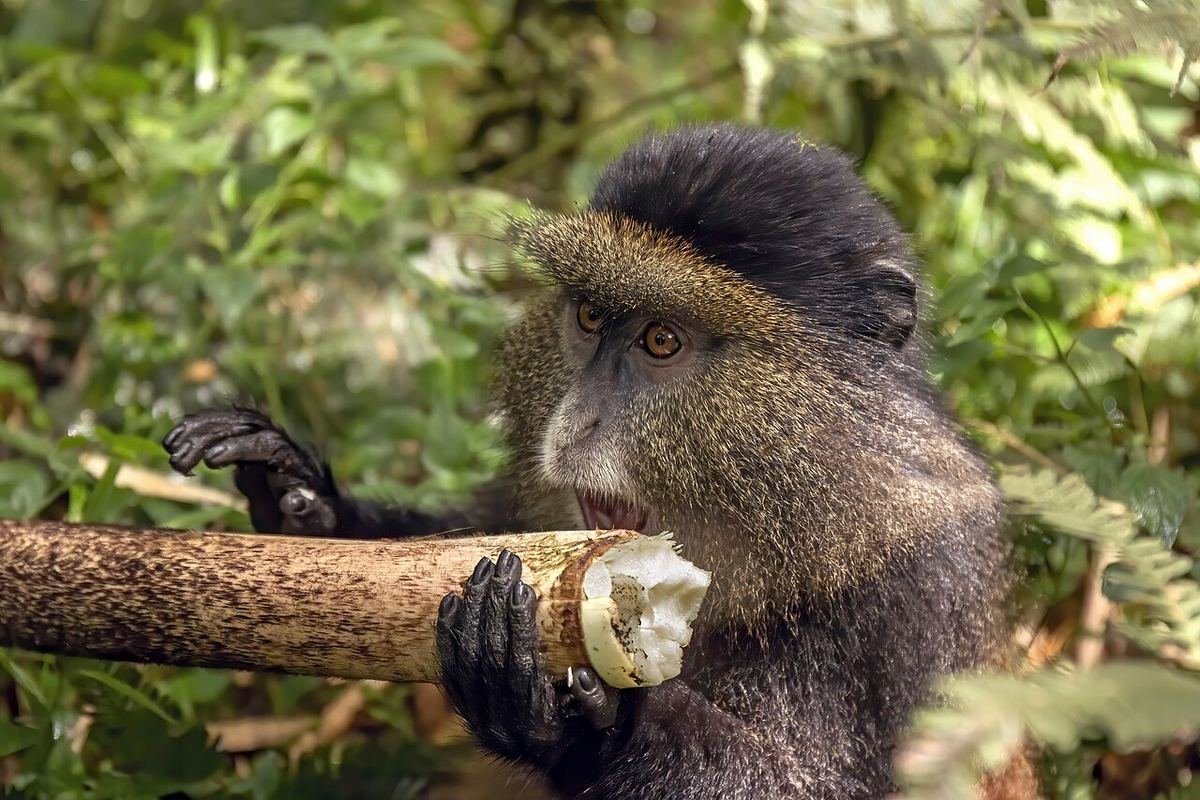
With its golden-orange back, black limbs and endless energy, the golden monkey is the most colourful primate of the Virunga volcanoes. It lives only in a small patch of the Albertine Rift, and seeing a troop feeding in the bamboo is one of the most cheerful wildlife experiences in East Africa. Here’s what to know.
Golden monkey facts
- Name: Cercopithecus kandti. Many scientists, and the IUCN, treat it as a subspecies of the blue monkey, Cercopithecus mitis kandti. The name honours Richard Kandt, the German explorer who founded Kigali.
- Status: Endangered on the IUCN Red List, because its range is so small.
- Home: high montane forest, especially the bamboo zone on the slopes of the volcanoes.
- Diet: mostly young bamboo leaves and shoots, plus fruit, flowers and insects.
- Groups: troops usually number up to about 30 monkeys, though much larger groups have been recorded.
- Busy by nature: they’re quick, acrobatic and always on the move, jumping from stem to stem in the bamboo, which keeps photographers on their toes.
Where golden monkeys live
According to the regional golden monkey conservation action plan (2023–2028), viable populations survive in just a handful of places:
- Uganda: Mgahinga Gorilla National Park, the only place in the country to see them, where the park’s slogan is “where gold meets silver”.
- Rwanda: Volcanoes National Park, which holds by far the largest population (estimated at over 4,600 in 2017–18), and a small, isolated population in Gishwati-Mukura National Park.
- DR Congo: the Virunga National Park side of the volcanoes, where the population has never been surveyed.
The Uganda population has declined sharply since the late 1990s. The Uganda Wildlife Authority links this mainly to habitat pressure, especially bamboo harvesting, which makes every tourist visit to Mgahinga a direct contribution to protecting them.
Tracking vs habituation
There are two ways to see golden monkeys:
- Golden monkey tracking: you hike into the bamboo with a ranger to find a habituated troop, then usually spend an hour with them. In Mgahinga it costs US$60 per foreign non-resident. In Rwanda, the Rwanda Development Board charges US$100, with a minimum age of 12 and up to 16 people per group; treks start from the Kinigi headquarters.
- Golden monkey habituation experience: offered in Mgahinga for US$100. You join the team working with a troop that’s still getting used to people, and spend longer with them. It suits photographers and anyone keen on primate behaviour.
In both cases, Uganda’s fees exclude park entrance, and prior booking is needed. Treks are generally shorter and gentler than gorilla treks, and are open to younger travellers than gorilla trekking, which has a minimum age of 15. Ask us for the current age rule for your family.
Practical tips
- Pace yourself: Mgahinga and Volcanoes are high, so walk slowly and drink plenty of water.
- Dress for the bamboo: waterproof boots, long trousers, long sleeves and a rain jacket.
- Camera settings: the monkeys move fast in dim light, so use a fast shutter speed. Flash isn’t allowed.
- Pair it with gorillas: in Rwanda you can do golden monkeys and gorillas on back-to-back days from the same lodge; in Uganda, combine Mgahinga with gorillas in Bwindi’s southern sectors.
Where to stay
Near Mgahinga, Mount Gahinga Lodge sits right by the park gate, and Amajambere Iwacu Community Camp is a good-value community-run option. In Rwanda, lodges around Kinigi, such as Mountain Gorilla View Lodge or Da Vinci Gorilla Lodge, are close to the Volcanoes park headquarters. See more in our accommodation guide.
Golden monkeys on your trip
Golden monkeys are the perfect partner to a gorilla trek. For three ways to combine them with gorillas and chimpanzees, see our three primate routes. Tell us where you’d like to fly in, and we’ll plan the rest.
Prices are set by the wildlife authorities and can change. We confirm the current rate when we quote your trip.
Found this useful? Send it to someone planning a trip.


