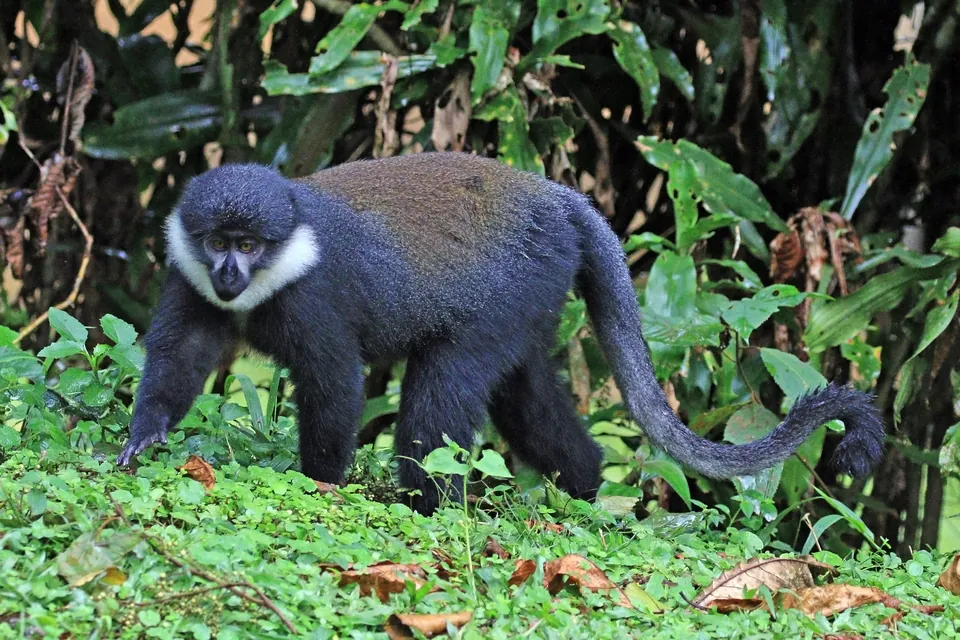
Most monkeys in Bwindi look down at you from the trees. L’Hoest’s monkey is more likely to cross the trail in front of you, walking on all fours with its tail curled up like a shepherd’s crook. It’s shy, so a good sighting is something guides are pleased about too.
Name and classification
- Common names: L’Hoest’s monkey, mountain monkey. It’s named after François L’Hoëst, a director of Antwerp Zoo.
- Latin name: Allochrocebus lhoesti. Older books call it Cercopithecus lhoesti.
- Family: Cercopithecidae. It’s one of the guenons, though in its own genus.
- IUCN status: Vulnerable, mainly because of forest loss and hunting with snares and dogs.
Native origin
This monkey has a small range in the upper eastern Congo Basin and the Albertine Rift: north-eastern DR Congo, Rwanda, Burundi and western Uganda. In Uganda it lives in the forests of the south-west and the Rift, including Bwindi, Kibale, Kalinzu, the Maramagambo Forest in Queen Elizabeth National Park, and the Kyambura Gorge area.
Its habit of feeding on the ground makes it more exposed than the tree-top monkeys. Snares set for duikers and bushpigs catch L’Hoest’s monkeys too, and hunting with dogs takes a toll outside the parks. Clearing for farms has also broken its range into separate forest blocks, which is why the national parks matter so much.
Physical appearance
The coat is short and dark, sooty grey to brown, with a chestnut saddle across the back. The striking part is the head: a dark face, light grey cheeks and a bright white bib or beard under the chin. Males weigh about 6 kg and females around 3.5 kg. The body is roughly 30–70 cm long and the tail is often longer, with a hook at the end that it carries raised when walking. If you see a dark monkey on the ground with a white beard and a question-mark tail, you’ve found one. Young animals look similar but have a less obvious chestnut saddle.
Habitat and diet
L’Hoest’s monkeys like montane and mid-altitude forest with thick undergrowth, along with forest edges and gaps where herbs grow well. They feed mostly on fruit, leaves, herbs, roots and mushrooms, much of it found on or near the ground. Now and then they take eggs, lizards and small birds. They sometimes visit gardens on the edge of the forest, which can put them in conflict with farmers.
Behaviour and special abilities
- Ground-dwellers: they spend much more time on the forest floor than most guenons, and climb into the trees to sleep or when they’re alarmed.
- Female-led groups: groups are fairly small, built around related females with a single adult male. Males leave home when they grow up.
- Early and late: they’re most active in the early morning and late afternoon, which is when your chances are best.
- Quiet: they make far less noise than red-tails or colobus, and they freeze or slip away rather than call loudly. Walk softly and stop often.
- Sitting sleepers: at night they sleep sitting upright in trees, like most Old World monkeys.
Where to see L’Hoest’s monkey in Uganda
- Bwindi Impenetrable National Park, often seen on the way to or from a gorilla trek.
- Kibale National Park and Bigodi Wetland.
- The Maramagambo Forest in Queen Elizabeth; see our Maramagambo guide.
- Kalinzu Forest.
Your best chance is a quiet early-morning or late-afternoon walk along a forest trail or road edge. Keep your voice down, and if one crosses the path, wait. Others from the group usually follow a few seconds later.
Compare it with the other guenons in our profiles of the blue monkey and red-tailed monkey, or browse primates of Uganda.
Found this useful? Send it to someone planning a trip.