You usually hear chimpanzees before you see them. A burst of pant-hoots goes up somewhere ahead, then the drumming of hands on a buttress root, and your guide starts walking faster. Uganda has one of the healthiest chimp populations in East Africa, and the Uganda Wildlife Authority’s 2026 wildlife report put the estimate at about 6,075, up from 5,072.
Name and classification
- Common names: chimpanzee, chimp. The ones in Uganda are eastern chimpanzees.
- Latin name: Pan troglodytes; the eastern subspecies is Pan troglodytes schweinfurthii.
- Family: Hominidae, the great apes. Chimps and bonobos are our closest living relatives.
- IUCN status: Endangered, because of habitat loss, hunting, snares and disease.
Native origin
Chimpanzees live across the forest belt of equatorial Africa, from Senegal and Guinea in the west to Uganda and Tanzania in the east. The eastern subspecies is found in the Central African Republic, South Sudan, DR Congo, Uganda, Rwanda, Burundi and Tanzania. In Uganda they live mostly in the forests of the west: Kibale, Budongo, Bugoma, Kalinzu, Maramagambo, the Kyambura Gorge, Semliki and Bwindi. Bwindi’s first chimp census, done in 2025 and announced in February 2026, estimated 426 chimpanzees living alongside the gorillas.
Physical appearance
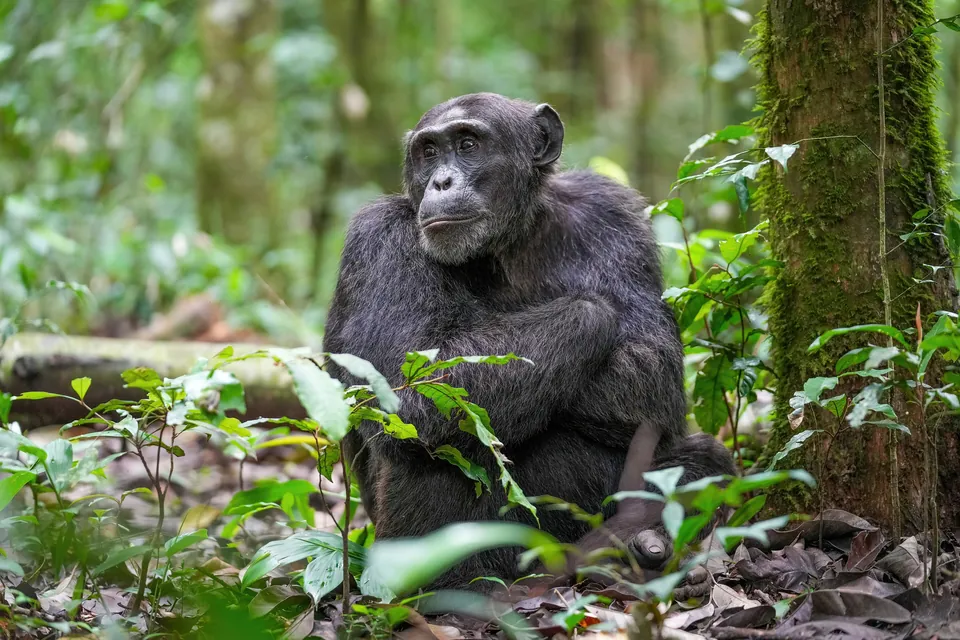
Adult eastern chimps weigh around 40–65 kg, with males heavier than females. Standing upright, a big male can reach about 1.4 m. The coat is black, sometimes greying with age, and the face, ears, hands and feet are bare. Young chimps have pale faces and a white tuft at the base of the spine, which they lose as they grow. The arms are longer than the legs, and on the ground chimps walk on their knuckles. Older adults often go bald on the forehead, and you can tell individuals apart by face shape and ears much as you would people.
Habitat and diet
In Uganda chimps are mainly animals of moist tropical forest, though some live in riverine strips and forest patches in savanna, such as the Kyambura Gorge. They feed mostly on ripe fruit, with figs a staple, and fill the gaps with leaves, pith, flowers, seeds, bark and insects. They also eat meat now and then. In Kibale they hunt red colobus monkeys, often as a team, and share the meat afterwards.
Behaviour and special abilities
- Fission–fusion life: a community can have anywhere from about 20 to more than 150 members, but they spend most of the day in small, shifting parties. The Ngogo community in Kibale, with nearly 200 chimps, is the largest known.
- Tool use: chimps use sticks to fish for termites and ants, and chewed leaves as sponges to soak up water from tree holes. Different communities have their own habits.
- Loud talk: pant-hoots carry a long way and help scattered parties keep track of each other. Drumming on big roots does the same job.
- Border patrols: males walk the edges of their range in quiet groups and can be violent towards neighbouring communities.
- Nests: each adult builds a sleeping nest high in a tree every night.
- Long childhood: infants stay close to their mothers for about five years, and chimps can live past 40 in the wild.
Where to see chimpanzees in Uganda
- Kibale National Park is the best bet, with habituated communities and the option of a longer habituation day. Add a walk in Bigodi Wetland next door.
- Budongo Forest, an easy add-on to Murchison Falls.
- Kalinzu Forest and the Kyambura Gorge, both close to Queen Elizabeth National Park.
- Ngamba Island in Lake Victoria, home to rescued orphans, and the wildlife centre in Entebbe.
Chimp permits are sold by the Uganda Wildlife Authority and run short in the busy months, so book ahead. The monkeys chimps share the forest with are in our profiles of the red colobus and red-tailed monkey. For gorillas, see mountain gorilla facts, and for the full line-up, primates of Uganda.
Found this useful? Send it to someone planning a trip.