Most visitors spend two weeks in Uganda and never see a snake. They’re here, though, in good numbers. Recent counts put Uganda’s reptile list at roughly 175 species, and a large share of those are snakes. Most are harmless and shy, and nearly all will leave long before you arrive.
Name and classification
Snakes are reptiles in the order Squamata, the same order as lizards, grouped as the suborder Serpentes. In Uganda you’ll meet several families: pythons (Pythonidae), vipers and adders (Viperidae), cobras and mambas (Elapidae), and the big family of “typical” snakes (Colubridae and relatives), which includes the green snakes and the boomslang. In Luganda a snake is omusota.
Native origin
All the species in this post are native to Africa. Uganda sits where the West and Central African rainforest belt meets East African savanna, so it has forest snakes such as the Gaboon viper and Jameson’s mamba alongside savanna species like the puff adder and black mamba.
Physical appearance
Vipers tend to be thick-bodied with broad, triangular heads and patterned skin that vanishes into leaf litter. Mambas and green snakes are long and slim. Cobras spread a hood when threatened. Pythons are heavy and muscular. Colour alone is a poor guide: harmless green snakes look like mambas, and the black mamba isn’t black.
Habitat and diet
Snakes live everywhere from Kampala gardens to papyrus swamps and mountain forest. All of them are carnivores, from frog and lizard eaters to big pythons that can swallow an antelope. Rats around homes and grain stores are the main reason snakes turn up near people, so they’re doing farmers a favour.
Behaviour and special abilities
Snakes “smell” with their forked tongue and feel vibration through the ground, which is why they usually move off when they hear footsteps. Pythons kill by constriction, venomous species use fangs, and a few cobras can spit venom at the eyes. The snakes that cause most trouble are those that sit still and rely on camouflage, because people step on them.
Notable Ugandan snakes
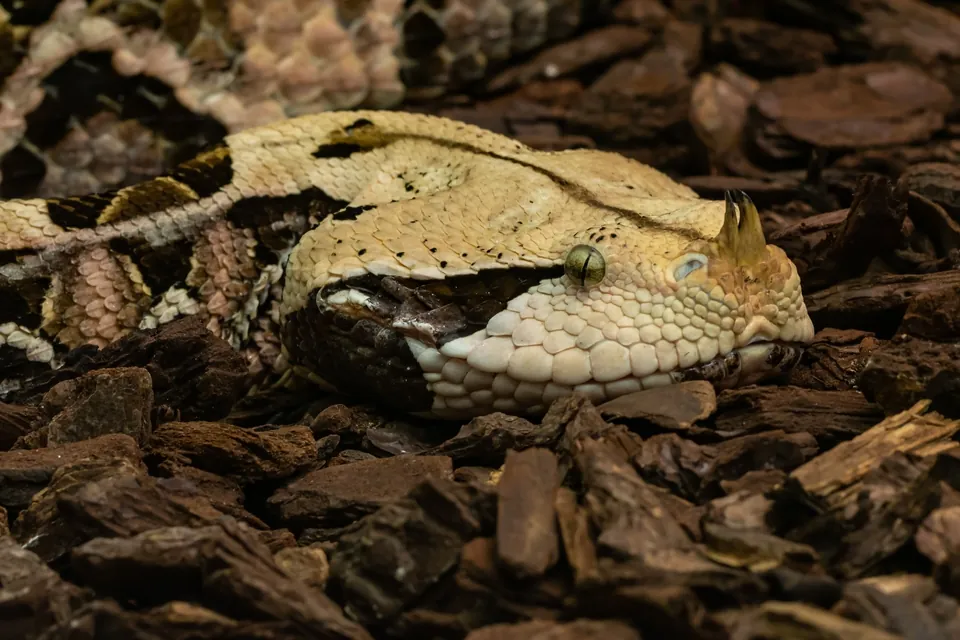
- Gaboon viper (Bitis gabonica): a heavy, beautifully patterned forest viper that lives in Ugandan forests and nearby grassland. Adults are usually 1.25–1.55 m and its fangs, up to about 5 cm, are the longest of any snake. It’s famously placid and rarely bites unless trodden on or handled.
- Rhinoceros viper (Bitis nasicornis): the forest viper with a cluster of horn-like scales on the tip of its nose and a startling pattern of blue, green, black and red. It likes damp forest near streams.
- Puff adder (Bitis arietans): the savanna cousin, widespread across Uganda. It lies still and trusts its camouflage, so it’s the snake most likely to be stepped on. Watch your feet on paths at dusk.
- Black mamba (Dendroaspis polylepis): actually grey to dark brown. The name comes from the inky-black inside of its mouth, shown when it’s threatened. Adults are usually 2–3 m. It has a fearsome reputation but generally flees, and bites people only when cornered.
- Jameson’s mamba (Dendroaspis jamesoni): a dull green, black-mottled tree mamba of Uganda’s forests. It spends most of its life in dense foliage and is shy, so bites are rare.
- Forest cobra: a large, glossy cobra often found near water and a good swimmer. Uganda’s animals are now usually called the brown forest cobra (Naja subfulva), split from the older Naja melanoleuca. Uganda also has the black-necked spitting cobra (Naja nigricollis).
- African rock python (Python sebae): Uganda’s biggest snake, usually 3–3.5 m long. It isn’t venomous. The female coils around her eggs and guards them, which is unusual for a snake. Attacks on people are exceptionally rare.
- Green snakes (Philothamnus): slender, bright green and harmless, with about a dozen species in Uganda, including one called the Uganda green snake (Philothamnus bequaerti). They’re the “green mambas” most people actually see.
Staying safe
Snakebite is a real health problem in rural Uganda, mostly for farmers walking barefoot or working in fields at night. As a visitor on a guided trip your risk is very low, and a few habits make it lower still.
- Wear closed shoes on walks, use a torch after dark, and look before you sit on logs or reach into undergrowth.
- If you see a snake, stop, back away slowly and give it room. Never try to catch or kill it.
- If someone is bitten: keep them calm and still, take off rings and watches, keep the bitten limb still and get to a hospital quickly. Don’t cut the wound, suck it, use a tight tourniquet or rely on herbal remedies. A photo or description of the snake helps, but don’t go looking for it.
- If a cobra spits in someone’s eyes, rinse them with lots of clean water and get medical help.
For more on health on the road, see our guide to staying healthy and safe on safari.
Where to see snakes in Uganda
- Uganda Reptiles Village, near Entebbe: a small rescue centre in Abaita Ababiri, started in 2004 by Yasin Kazibwe, which takes in snakes, crocodiles, tortoises and chameleons. It struggled during the pandemic, so check it’s open before you go.
- Uganda Wildlife Conservation Education Centre in Entebbe, which has kept rock pythons among its rescued animals.
- The bat cave in Maramagambo Forest, where pythons hunt fruit bats, watched from a viewing hide.
Found this useful? Send it to someone planning a trip.