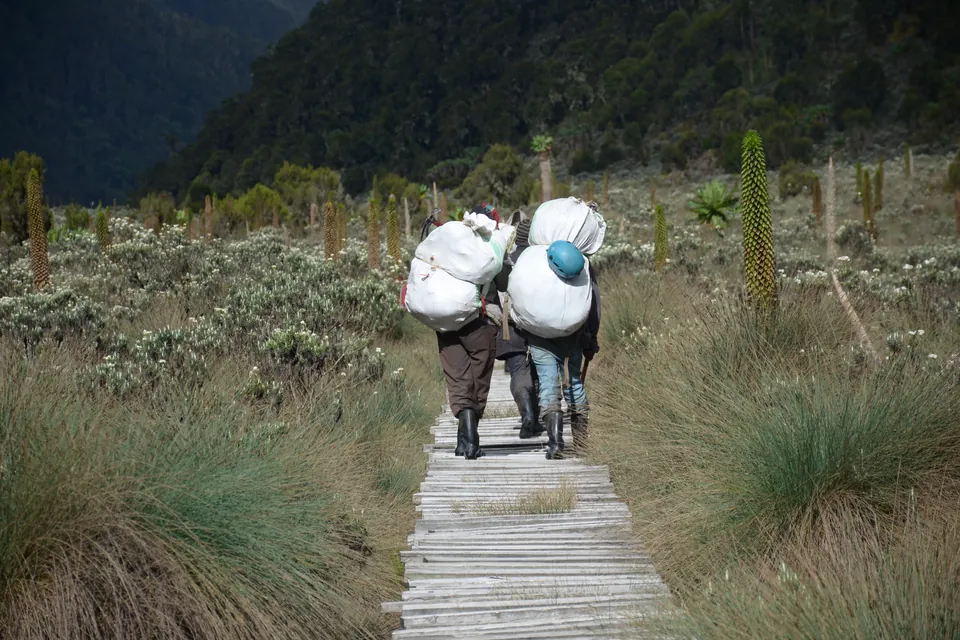
If you climb the Rwenzori, the porters and guides who get you up there are almost always Bakonzo. Their villages climb the mountain slopes to around 2,200 metres, with gardens so steep you wonder how anyone stands up to hoe them. Most live in Kasese, Bundibugyo, Bunyangabu and Ntoroko districts, with more across the border in Congo. They speak Lhukonzo, and the name is also spelt Bakonjo.
Origins and how the group came to be
Bakonzo stories differ. One says the people came from the Mount Elgon area and moved west over many generations. Another says they’ve always been on the Rwenzori, and that their first ancestor came out of a cave on the mountain. Either way, the mountain is at the heart of their identity.
For most of the 20th century the Bakonzo were ruled as part of Tooro. In the early 1960s the Rwenzururu movement, led by Isaya Mukirania, pushed for self-rule. The name means roughly “land of snow”. Years of conflict followed, and the government formally recognised the Rwenzururu kingdom, shared by the Bakonzo and Bamba, in 2008. Its king is the Omusinga.
The current Omusinga is Charles Wesley Mumbere, crowned in 2009 after years living in the United States. He was arrested after deadly clashes between security forces and royal guards in Kasese in November 2016. The charges were withdrawn in 2023. As of October 2026 he has been abroad for medical care in Turkey, and the kingdom moved its anniversary celebrations to 14 November 2026.
Day-to-day life
Most Bakonzo are farmers. On the lower slopes you’ll see coffee, cocoa, bananas, beans, cassava and yams, with goats, sheep and chickens around the homestead. Higher up, families walk long distances on foot paths carrying loads to market. Many young men work as guides and porters in the national park.
Society is built around 14 clans, each with a totem animal that members must not kill or eat. Only the royal clan can produce an Omusinga.
Weddings and marriage customs
A Bakonzo marriage moves in stages. At erisunga, the bride’s family meets the groom’s family, sizes them up and agrees the bride wealth, or omukagha. This was traditionally around 12 goats, with local brew, a hoe and gifts for the bride’s mother. The marriage is recognised on erithahya, the day the bride wealth is handed over. Today most couples add a church or mosque wedding and a “give-away” party.
Rituals and ceremonies
Bakonzo belief tells of Nyamuhunga, the creator, and of Kithasamba, the spirit linked with the snowy peaks. Many Bakonzo are Christian or Muslim today, but respect for the mountain and its spirits runs deep.
Circumcision was long the mark of adulthood for men. The large shared ceremony faded in the 1970s, and the custom is being revived in some areas. Births of twins come with their own naming and ceremonies, and clans hold cleansing rites every few years.
Music, dance and storytelling
The dance you’re most likely to see is ekikebi, a happy courtship dance for weddings. Men and women face each other in lines, move forward and back, and pair up in the middle with a fast chest movement. The omukumu was once danced only by young men in initiation seclusion, beating sticks of different lengths to make interlocking rhythms. School and cultural groups now perform it in public.
The big instrument is the endara, a large xylophone laid across banana stems and always played with three drums. There’s also eluma, a set of whistle flutes played by men, each blowing one note in turn.
Food and culinary experiences
Meals are built on cassava, sweet potatoes, yams, matooke and beans. Firinda, the mashed bean dish of the Rwenzori region, is a Bakonzo favourite too. Banana beer and a brew called tonto turn up at weddings and ceremonies. If you stay in a village, you may get to pick and roast coffee with your hosts.
Cultural experiences for visitors
- Do a village walk on the lower slopes of Rwenzori Mountains National Park. Community-run camps near the park gate offer homestead visits and dance evenings.
- Climb with Bakonzo guides. Read our Margherita Peak guide.
- Combine Kasese with Queen Elizabeth National Park and the Lake Katwe salt works.
- Ask before photographing shrines or ceremonies, and tip guides and porters fairly. See our tipping guide.
Found this useful? Send it to someone planning a trip.