
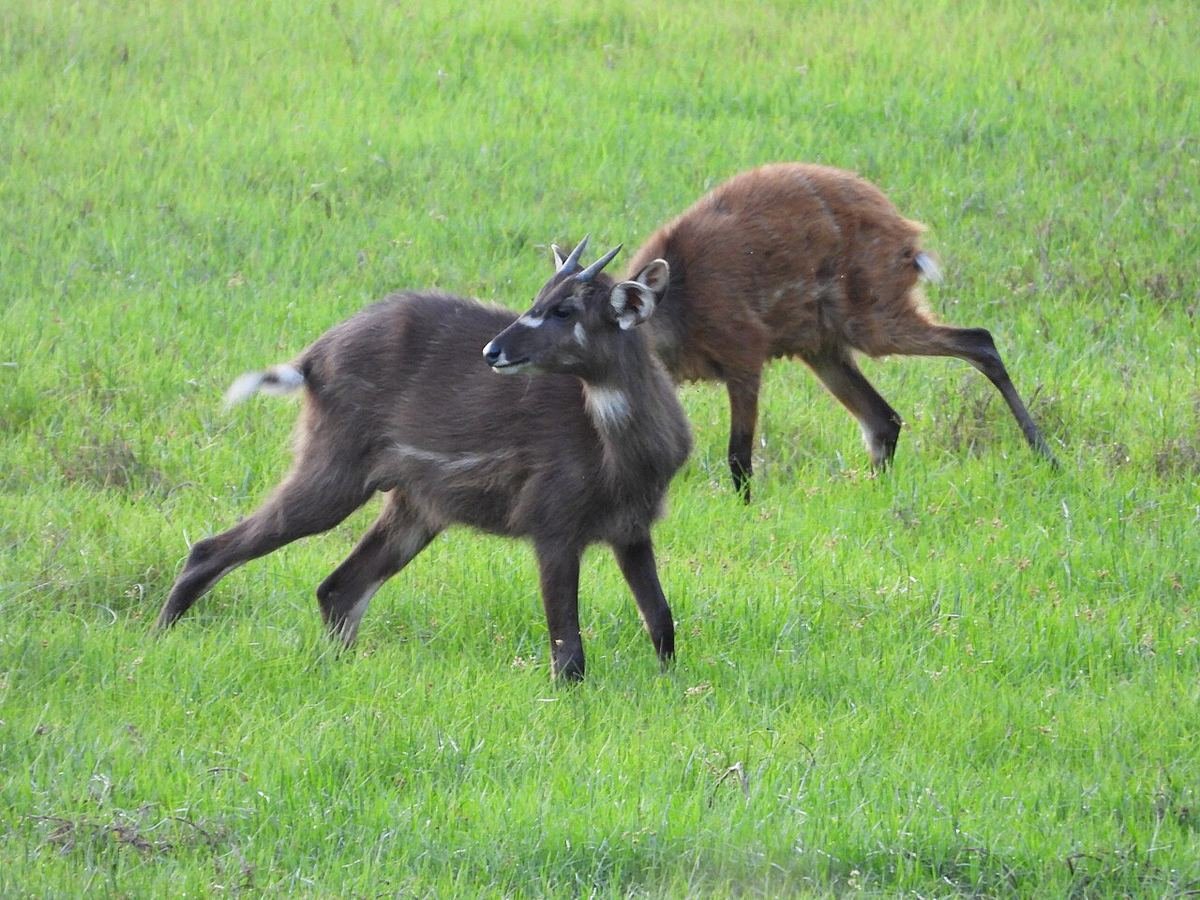
Most antelopes avoid deep water. The sitatunga lives in it. This shy, shaggy antelope spends its life in papyrus swamps and reed beds, where few predators can follow. It’s one of the hardest antelopes in Africa to see well, which makes a sighting all the more special. Here’s what to know, and where to look.
Built for the swamp
- Splayed hooves: the sitatunga’s long, pointed hooves spread wide as it walks, spreading its weight so it can move over floating vegetation and soft mud where other antelopes would sink.
- Water-resistant coat: a long, oily coat helps shed water.
- The hiding trick: when threatened, a sitatunga may sink into the water until only its nose and eyes are above the surface.
- Males and females look different: males are larger and darker, with a shaggy mane and spiralled horns that can reach around 90 cm. Females are smaller, chestnut-red and hornless.
- Diet: fresh grasses, sedges and leaves from the swamp and its edges.
The sitatunga, Tragelaphus spekii, belongs to the same family group as the bushbuck, kudu and eland. Its scientific name honours John Hanning Speke, who recorded it on his travels in the region in the 1860s. The IUCN lists it as Least Concern across Africa, but it depends entirely on healthy wetlands, and drainage of swamps for farming and hunting have made it scarce in many places.
Why they’re so hard to see
Sitatungas are mostly active early and late in the day, stay deep inside tall papyrus and freeze or slip away at the first sign of people. Sightings are never guaranteed. The best chances come from waiting quietly at the swamp edge, gliding through the channels by canoe, or watching from a raised platform at first light.
Where to look in Uganda
- Lake Mburo National Park: sitatungas live in the swamps that fringe the park’s lakes. They keep to the swamp interiors, so scan the papyrus edges on the boat trip and on early walks.
- Bigodi Wetland Sanctuary: the community-run Magombe Swamp next to Kibale is home to sitatungas and bushbucks, as well as primates and more than 200 bird species. Most visitors see monkeys and birds; a sitatunga is a lucky bonus.
- Katonga Wildlife Reserve: a little-visited wetland reserve where canoe trips with a ranger take you into the kind of habitat sitatungas love.
Elsewhere in East Africa
- Saiwa Swamp National Park, Kenya: Kenya’s smallest national park, only about 3 km², near Kitale. It was created in 1974 specifically to protect the sitatunga.
- Rubondo Island National Park, Tanzania: an island park in the south-west of Lake Victoria where sitatungas are native and among the characteristic animals of the lake shore.
- Akagera National Park, Rwanda: the papyrus swamps and lake edges of this savanna park also hold sitatungas.
Practical tips
- Go early: first light is the best time, and the water is calmest for canoe trips.
- Be patient and quiet: keep voices low and move slowly along boardwalks and swamp edges.
- Bring binoculars: you’ll often spot only a head or a pair of horns in the papyrus.
- Wear muted colours and waterproof shoes; swamp trails can be wet all year.
- Combine it: a Bigodi swamp walk fits easily into the afternoon after a morning of chimpanzee tracking in Kibale.
Where to stay
At Lake Mburo, Mihingo Lodge, Rwakobo Rock and Mantana Tented Camp all put you close to the park’s trails and lake. Near Bigodi, lodges around Kibale such as Primate Lodge Kibale and Kibale Forest Camp are only a short drive away. Browse more options in our accommodation guide.
Looking for the sitatunga with us
If you enjoy the quieter side of safari, such as wetlands, birds and patient wildlife watching, the sitatunga is a wonderful animal to build a morning around. It also appears in our wider guide to Uganda’s antelopes. Tell us your interests and we’ll plan early starts in the right places.


