
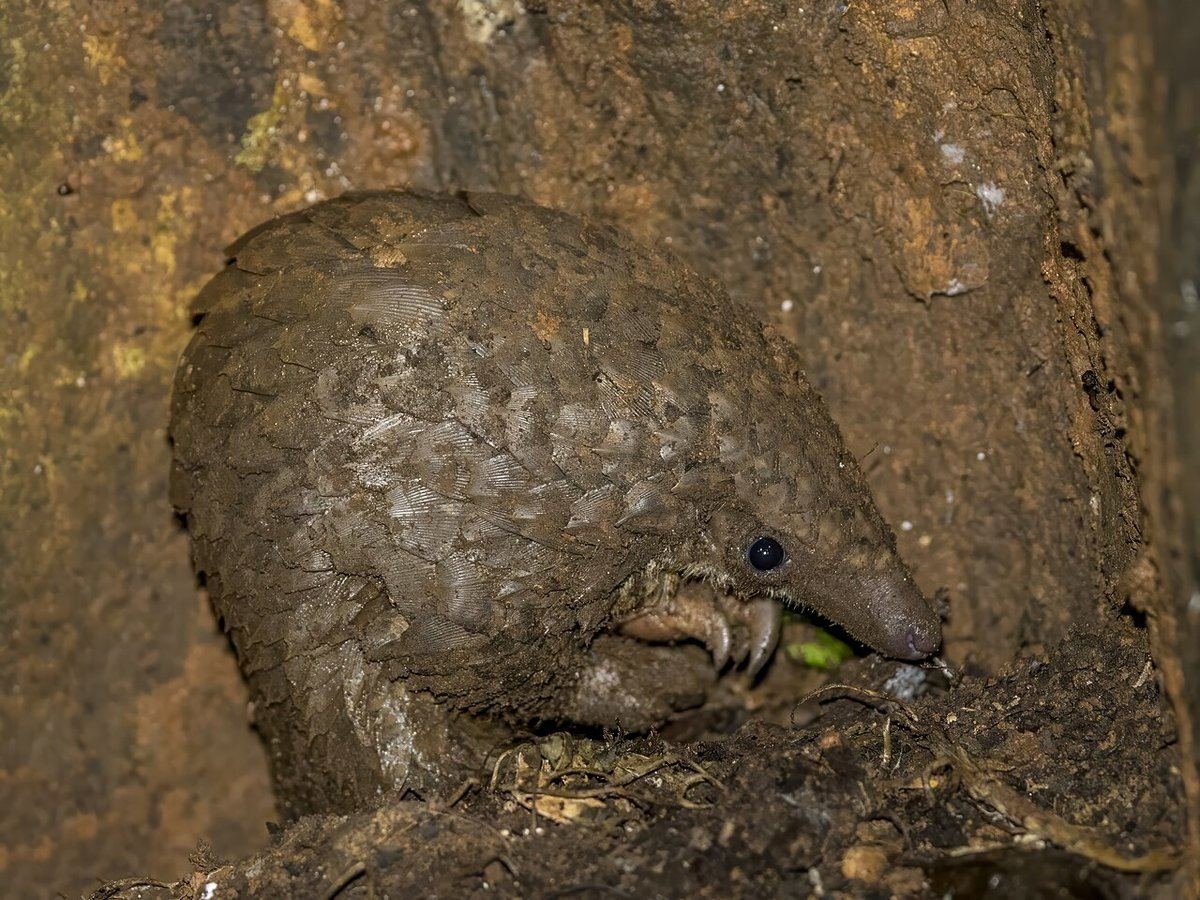
Pangolins are among the strangest and most endearing mammals in Africa. Covered in overlapping scales, they walk on their back legs or curl into a tight ball when threatened, and feed almost entirely on ants and termites with a long, sticky tongue. They’re also the most heavily trafficked wild mammals in the world. Uganda is one of the few countries that may be home to all four African species.
How pangolins live
Pangolins are mostly solitary and nocturnal. They have no teeth. Instead they use powerful front claws to rip open ant nests and termite mounds, and a long tongue to lap up the insects. Their scales are made of keratin, the same material as our fingernails, and make up a large part of their body weight. When danger threatens, a pangolin rolls into a ball with its scales facing outwards, a defence that works well against lions but, sadly, makes it easy for people to simply pick one up. Females usually give birth to a single young, which rides on its mother’s tail or back. That slow breeding rate is one reason pangolin populations struggle to recover from hunting.
Uganda’s four pangolins
According to the Uganda Wildlife Authority’s 2026 State of Wildlife Resources report, three species are confirmed by recent records, and a fourth is thought to occur.
- Giant pangolin (IUCN: Endangered): the largest pangolin, up to about 1.8 m long and 40 kg. It lives on the ground and in Uganda is rare and almost entirely confined to protected areas, mainly in the centre and south-west, where it prefers lower ground with good tree cover.
- Temminck’s ground pangolin (Vulnerable): also terrestrial, averaging around 10 kg. It favours savanna and open woodland in northern Uganda.
- White-bellied or tree pangolin (Endangered): small (1–3 kg), semi-arboreal and found in forests south of the Nile. It can survive in farmland and villages where trees remain.
- Black-bellied or long-tailed pangolin (Vulnerable): a fully tree-living forest species. It’s on Uganda’s list of threatened species, but there are no recent verified records from inside the country. If it’s present, it would be in the western lowland forests.
Why pangolins are in trouble
All pangolins are listed on Appendix I of CITES, which bans international commercial trade. Even so, they’re hunted for meat and for their scales, which are used in traditional medicine, mostly to supply markets in Asia. UWA reports that Uganda is both a source and a transit country, with more than 9,990 kg of scales, 56 live pangolins and 36 skins seized over the past decade. Wire snares set for other animals also catch pangolins, and habitat loss, electric fences and roads add to the pressure.
Research and rescue in Uganda
- Ziwa Rhino Sanctuary: in 2019 a Chester Zoo team working with Rhino Fund Uganda and UWA released rare camera-trap footage of giant pangolins at Ziwa, including one balancing on its tail against a tree and a youngster riding on an adult’s back.
- Murchison Falls: since 2022 Chester Zoo has run a long-term research camp in Murchison Falls National Park, with UWA and other partners. Its camera-trap surveys show the park is a stronghold for giant, white-bellied and Temminck’s pangolins.
- Uganda Conservation Foundation: its Pangolin Conservation Project, funded by the David Shepherd Wildlife Foundation and run with UWA, trains wildlife handlers, equips teams to care for pangolins rescued from traffickers, and has identified safe release sites in Murchison Falls.
Can you see a pangolin on safari?
Honestly, it’s very unlikely. Pangolins are nocturnal, secretive and rare, and there’s no pangolin viewing activity for visitors in Uganda. A few lucky travellers see one on a night drive or walking near a lodge after dark, but even guides who spend their lives in the bush may see only a handful. The best way to “meet” them is to visit the parks that protect them, and to learn about the research while you’re there.
Good to know
- Try a night drive. Guided night drives in Murchison Falls or Lake Mburo are your best (small) chance of seeing any nocturnal mammal.
- If you do see one, keep your distance, use a dim red light rather than a bright torch, and never pick it up.
- Never buy wildlife products, including anything made from scales, and report anything suspicious to your guide or UWA.
- Choose responsible operators. Your park fees help fund rangers who patrol against snares and trafficking. Our post on sustainable safari choices has more ideas.
Plan it with us
Murchison Falls and Ziwa make a great conservation-focused trip: rhinos on foot, lions and leopards on the northern bank, and the chance of a night-time surprise. Get in touch and we’ll plan it with you.


