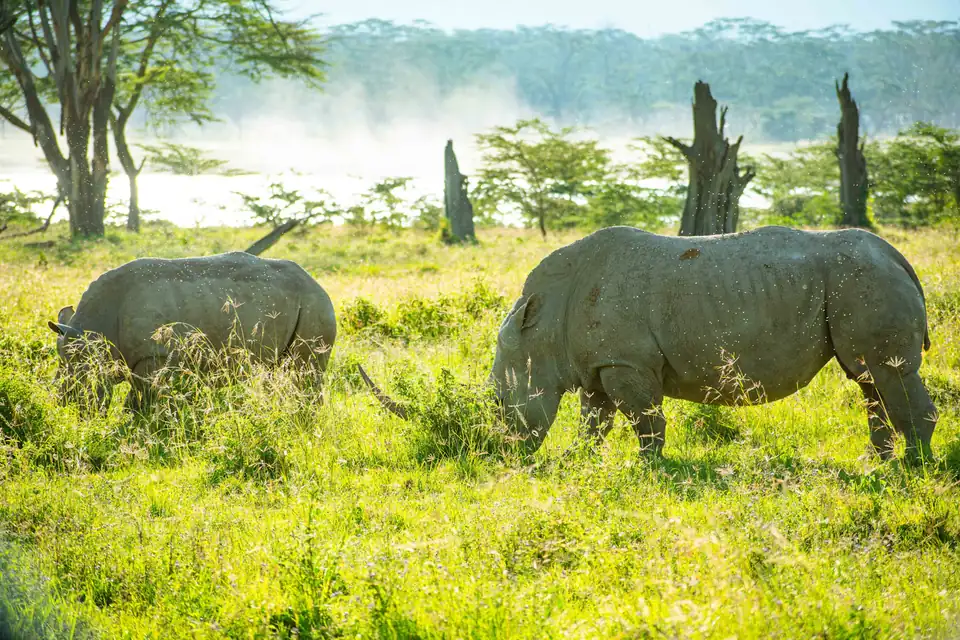

Walking quietly through the bush behind a ranger and stopping a safe distance from a grazing white rhino is one of the most memorable experiences in Uganda. It’s possible because of Ziwa Rhino Sanctuary, the breeding ground that has brought rhinos back to a country that had lost them all.
How Uganda lost its rhinos
Uganda was once home to two kinds of rhino: the northern white rhino, protected in places such as Ajai in the West Nile region, and the eastern black rhino. During the years of conflict and instability in the 1970s and early 1980s, both were poached out. The Uganda Wildlife Authority records that the northern white rhinos of Ajai had been wiped out by 1979, and that the last eastern black rhino was killed in Kidepo in 1983.
The comeback
- 2005–2006: four southern white rhinos arrived from Solio Ranch in Kenya, followed by two from Disney’s Animal Kingdom in the USA. These six became the breeding stock at Ziwa.
- By 2025: the Ziwa herd had grown to close to 50, a growth rate of around 11% a year.
- December 2025: eight more white rhinos arrived from South Africa to add fresh genes.
- January 2026: four rhinos were moved from Ziwa to Ajai Wildlife Reserve, the first time Uganda has moved rhinos between its own protected areas.
- March 2026: rhinos returned to Kidepo Valley National Park, in a protected sanctuary in the Narus Valley. They’re the first rhinos in Kidepo since 1983, with more planned.
UWA’s 2026 wildlife report puts Uganda’s southern white rhinos at around 60, with the large majority still at Ziwa.
Where Ziwa is
Ziwa covers about 70 km² of savanna and wetland in Nakasongola District, about 2.5 to 3 hours north of Kampala just off the Kampala–Gulu highway. That makes it a natural stop on the way to Murchison Falls National Park. It’s run by the Ziwa Rhino and Wildlife Ranch together with the Uganda Wildlife Authority.
How rhino tracking works
- Briefing: you start with a safety briefing from the rangers, who monitor the rhinos around the clock.
- Drive and walk: you usually drive a short way towards where the rhinos were last seen, then continue on foot with a ranger.
- Time: the activity typically takes 1.5 to 2.5 hours, depending on where the rhinos are. Tracking runs throughout the day.
- The encounter: you watch the rhinos from a safe distance chosen by your ranger, often a mother and calf or a small group grazing or resting in the shade.
What it costs
Fees at Ziwa have been revised in recent years. UWA’s 2024–2026 tariff lists park entry at US$20 and rhino tracking at US$30 for foreign non-residents, while the sanctuary’s own site has quoted a combined entry and tracking rate. As a guide, budget roughly US$50–60 per adult, with reductions for children. We’ll confirm the exact current fee when we quote your trip. From January 2027, UWA’s new tariffs also list rhino tracking at Ajai at US$20 for foreign non-resident adults.
Good to know
- Follow the ranger: rhinos are large and faster than they look. Keep together, keep quiet and never approach on your own.
- What to wear: closed shoes, long trousers and neutral colours. Bring water, a hat, insect repellent and your camera.
- Timing: early morning and late afternoon are cooler and the light is softer.
- More to do: an early-morning shoebill walk and canoe trip in the Lugogo swamp, birding, nature walks and night walks.
- Where to stay: Amuka Safari Lodge is inside the sanctuary, so you can track in the afternoon and head to Murchison the next morning.
Completing Uganda’s Big Five
With rhinos at Ziwa and lion, leopard, elephant and buffalo in Murchison, a four-day trip north from Kampala covers all of the Big Five. Rhino tracking at Kidepo and Ajai is still developing, so ask us for the latest before planning around it.
Every visit to Ziwa helps fund the rangers and breeding programme behind one of Africa’s most hopeful conservation stories. Tell us your dates and we’ll add rhino tracking to your Murchison safari.
Found this useful? Send it to someone planning a trip.