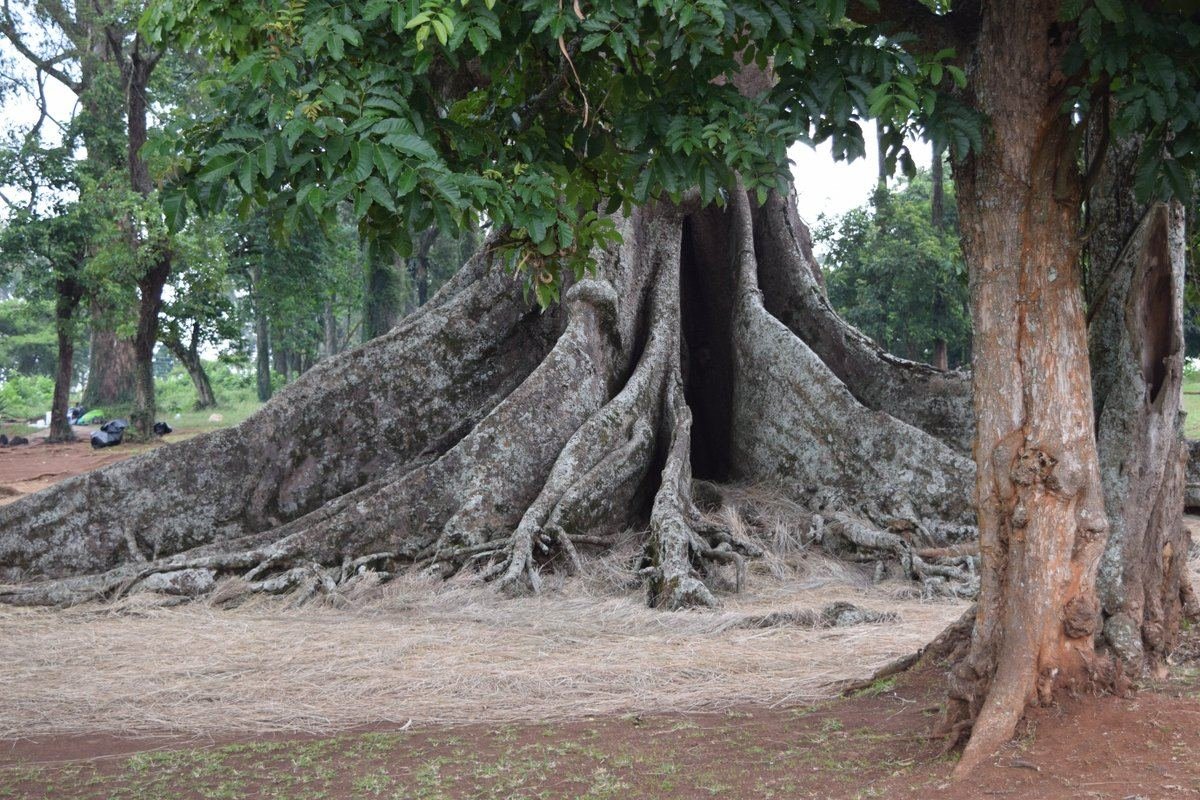
On a hilltop a few kilometres outside Mubende town, in central Uganda, stands a tree unlike any other. Its trunk rises from a skirt of enormous buttress roots, folded into chambers and hollows big enough to sit inside. This is the Nakayima Tree, one of the most important traditional spiritual sites in Uganda, and a place where legend, history and living belief meet.
The legend of Nakayima
The story belongs to the Bachwezi, the semi-legendary rulers of the ancient kingdom of Kitara, remembered in the oral traditions of Bunyoro, Tooro, Ankole and Buganda. According to these traditions, the Bachwezi were a dynasty of remarkable, almost god-like people who ruled the region centuries ago and then mysteriously disappeared.
Mubende hill is said to have been the seat of Ndahura, remembered as the first great Chwezi king. Nakayima is described in the stories as a woman of his household, often called his wife or his priestess. When the Bachwezi vanished, the legend says Nakayima stayed behind on the hill, and in some versions she disappeared into the tree itself. Her spirit is believed to live on there, and she is honoured as a powerful figure who can bring blessings, fertility and prosperity.
These are traditions, told differently by different families and custodians. Historians still debate who the Bachwezi really were, but there is no doubt about how much they mean to the people who come here.
The tree and the hill
The tree is said to be several hundred years old, though no one has dated it scientifically. What you notice first is its size and its roots, which form a series of natural “rooms”. Each chamber is associated with a different spirit or deity from the Chwezi tradition, and you’ll often see offerings placed inside: coins, coffee beans, bark cloth, grains and other small gifts.
The hill itself has views across the surrounding countryside, and archaeologists have found evidence of old settlement around Mubende, which adds to its sense of deep history. Custodians look after the site and explain its meaning to visitors.
Why Mubende matters
Mubende sits at the meeting point of several of Uganda’s old kingdoms, and its hill is one of a handful of places that different communities connect with the Bachwezi. Others include the earthworks at Bigo bya Mugyenyi and sites around Fort Portal and Bunyoro. Visiting more than one of them helps you see how widely these stories spread, and how they still shape local identity, spirituality and even the names of places today.
A living shrine
The Nakayima Tree is not a tourist attraction that happens to have a story. It is an active shrine. Pilgrims come from across Uganda to pray, give thanks and ask for help with health, children, work or love. Some stay for hours, and there are special gatherings at certain times of year. As a visitor you are a guest in someone else’s place of worship.
Visiting respectfully
- Go with a guide or custodian. They will explain the customs and tell you where you may and may not go.
- Dress modestly. Custodians often ask women to wear a long skirt or wrap rather than trousers. Carry a kitenge or sarong just in case.
- You may be asked to remove your shoes near the tree.
- Ask before photographing, and never photograph people who are praying without permission.
- Don’t touch or move offerings, and don’t climb on the roots.
- Some customs, including restrictions on who may enter certain areas, follow traditional beliefs. Follow them politely even if they’re unfamiliar.
Good to know
- Getting there: Mubende is roughly 170 km west of Kampala on the road to Fort Portal, so allow around three to four hours by road depending on traffic. The tree is a short drive from town.
- Timing: It fits neatly into a journey between Kampala and Fort Portal or Kibale National Park. Allow about an hour on site.
- Fees: Visitors usually pay a small fee for the upkeep of the shrine. We’ll confirm the current amount before you travel.
- Pair it with Bigo bya Mugyenyi, the great earthworks linked to the same Bachwezi traditions.
If you’re curious about the beliefs that shaped Uganda long before the colonial era, a stop at the Nakayima Tree is unforgettable. Tell us you’d like to include it, and we’ll plan the route, arrange a knowledgeable guide and make sure you arrive prepared.
Found this useful? Send it to someone planning a trip.