Count the giraffes in Uganda and you get about 2,500, according to the Uganda Wildlife Authority’s latest report. That doesn’t sound like many, but they’re Nubian giraffes, one of the rarest kinds, and Uganda has more of them than any other country.
Name and classification
Uganda’s giraffe is the Nubian giraffe, Giraffa camelopardalis camelopardalis. The animals once called Rothschild’s or Baringo giraffes are now counted as Nubian giraffes, so you’ll still see both names in books and on signs. The Latin camelopardalis comes from an old Greek idea of a “camel-leopard”: shaped a bit like a camel, spotted like a leopard.
In 2025 the IUCN’s giraffe specialists recognised four giraffe species instead of one. The Nubian giraffe sits within the northern giraffe, Giraffa camelopardalis. The IUCN has listed the Nubian giraffe as Critically Endangered, with only a few thousand left in the wild.
Native origin
Giraffes are found only in Africa. The Nubian giraffe’s home range is the north-east of the continent: South Sudan, western Ethiopia, Kenya and Uganda. Many of those populations have shrunk badly, which is why Uganda’s herds matter so much. Murchison Falls alone holds well over 2,000.
Physical appearance
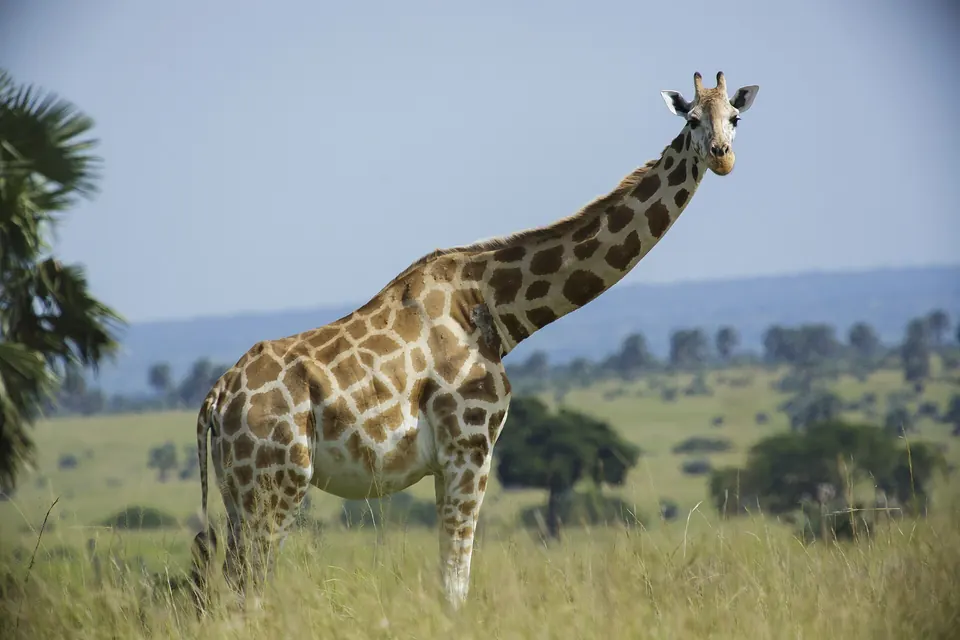
- Height: the tallest animal on Earth. Big males can reach about five and a half metres.
- White socks: Nubian giraffes have pale, unspotted legs below the knee.
- Patches: large, brown, clean-edged patches on a cream background.
- Horns: the bony horns are called ossicones. Males often grow extra bumps on the head as well as the two main ones.
- The neck: very long, yet with seven neck bones, the same number as ours. Each bone is just much longer.
Habitat and diet
Giraffes live in open savanna and wooded grassland. They are browsers, eating leaves, shoots and pods from trees and bushes, with acacia a favourite. A long, dark tongue lets them strip leaves from between thorns. They get much of their water from the leaves, so they can go a while without drinking. When they do drink, they splay their front legs wide to reach the water, which is when they’re most at risk from lions.
In Murchison you’ll often find them among the tall palms and scattered acacias north of the Nile, where the grass is short enough to pick them out from a long way off. In Lake Mburo they browse the acacia thickets between the ridges, sharing the ground with zebra, impala and eland.
Behaviour and special abilities
- Loose herds: groups join, split and rejoin. Herds of 20 or more are common in Murchison.
- Necking: two males swing their necks and knock heads to settle who’s in charge.
- A rough start: mothers give birth standing up, so the calf drops a couple of metres to the ground. It’s usually on its feet within an hour.
- Watchtowers: from that height giraffes spot predators early, and other animals watch them for a warning.
- Hitchhikers: look for oxpeckers riding on their necks, picking off ticks.
Uganda has been moving giraffes to rebuild old populations. Giraffes went from Murchison to Lake Mburo in 2015, and since 2016 some have been moved south of the Nile within Murchison. UWA’s 2026 report shows numbers rising, from 2,414 to 2,519.
Where to see giraffes in Uganda
- Murchison Falls National Park: by far the best, especially on the Buligi game tracks north of the river.
- Kidepo Valley: a smaller herd in the Narus Valley with mountains behind.
- Lake Mburo: the closest giraffes to Kampala, and walking safaris can bring you near.
- Pian Upe Wildlife Reserve: a small population in Karamoja, for travellers happy to go off the usual route.
Early morning and late afternoon give the best light. See our photography tips and the wider guide to Uganda’s safari animals.
Found this useful? Send it to someone planning a trip.