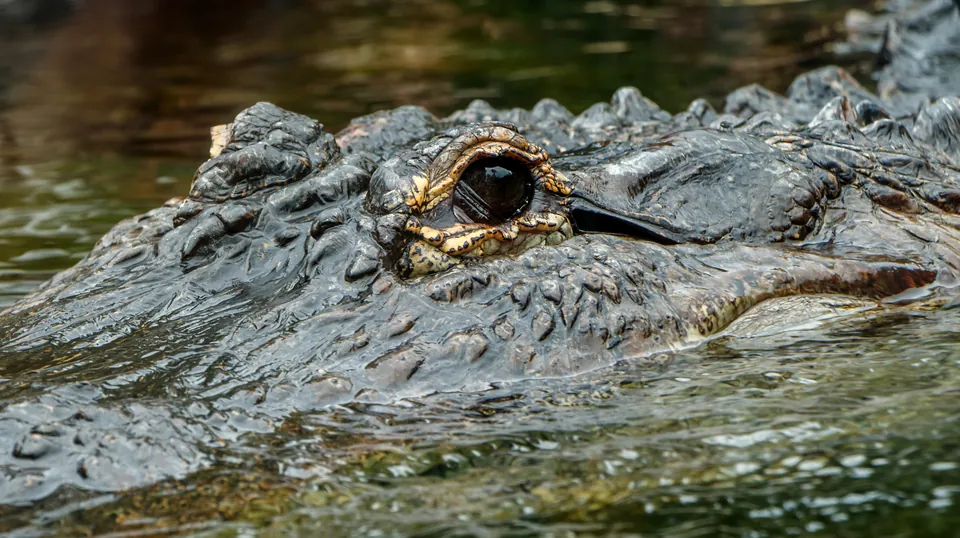
We get asked this often on the Murchison launch: “Is that an alligator?” The short answer is no. Uganda has no wild alligators. Every big reptile you see on a Ugandan riverbank is a crocodile, almost always the Nile crocodile. Here’s how the two groups differ and how to tell them apart.
Name and classification
Alligators and crocodiles are both crocodilians, in the reptile order Crocodylia, but they sit in different families. Alligators belong to Alligatoridae, along with the caimans of Central and South America. There are only two alligator species: the American alligator (Alligator mississippiensis) and the Chinese alligator (Alligator sinensis). Crocodiles belong to Crocodylidae, which includes the Nile crocodile (Crocodylus niloticus) and its relatives.
Native origin
The American alligator lives in the south-eastern United States, in places like Florida and Louisiana. The Chinese alligator survives in a small area of the lower Yangtze in eastern China and is Critically Endangered. Neither is native to Africa. Crocodiles, by contrast, live across the tropics of Africa, Asia, Australia and the Americas.
Uganda’s crocodilians are the Nile crocodile, which is common, and possibly the Congo dwarf crocodile (Osteolaemus osborni), a small forest species that some checklists include for the far west of the country but that is almost never seen. We were asked whether there are alligators in Ugandan zoos. We couldn’t find any reliable record of an alligator kept at the Uganda Wildlife Conservation Education Centre in Entebbe or at a Ugandan reptile park, so we won’t claim one. If you’ve seen a sign saying otherwise, we’d love to hear about it.
Physical appearance
- Snout: alligators have a broad, rounded U-shaped snout. Most crocodiles have a narrower, more pointed V-shaped one.
- Teeth: with its mouth shut, an alligator’s upper jaw covers the lower teeth, so you mostly see the top row. A crocodile’s upper and lower teeth line up, and the big fourth tooth of the lower jaw sticks up outside the upper lip, giving that toothy grin.
- Colour: American alligators are usually very dark, almost black. Nile crocodiles are olive to grey-brown.
- Size: large American alligator males reach about 4 m or a little more. Big Nile crocodile males commonly reach 3.5–5 m and some grow larger. The Chinese alligator is small, usually under 2 m.
Habitat and diet
Alligators are almost entirely freshwater animals of swamps, marshes and slow rivers. Many crocodiles have working salt glands on the tongue that let them cope with salty or brackish water, which is why some crocodile species live in estuaries and even cross the sea. Both are meat-eaters, taking fish, birds, mammals and carrion, with the largest individuals able to tackle big prey at the water’s edge.
Behaviour and special abilities
The two groups behave in very similar ways. Both are patient ambush hunters, both bask to warm up, and in both the temperature of the nest decides the sex of the young. Mothers of both guard their nests and carry hatchlings to the water in their mouths. Alligators cope with cooler weather and in the American south can survive cold snaps by keeping their nostrils above the ice. Nile crocodiles are generally the more dangerous of the two to people, so treat any you meet with respect.
Quick way to remember
Look at the face. A wide, rounded snout with hidden bottom teeth: alligator, and you’re probably in America or China. A pointed snout with teeth showing top and bottom: crocodile, and in Uganda, that’s the Nile crocodile.
Where to see crocodiles in Uganda
- The Nile below the falls in Murchison Falls National Park.
- The Kazinga Channel in Queen Elizabeth National Park.
- Uganda Reptiles Village near Entebbe, a small rescue centre that has kept crocodiles. Check it’s open before you go.
For the full story of Uganda’s crocodile, read our Nile crocodile facts.
Found this useful? Send it to someone planning a trip.