
Every safari has a moment when a guide stops the vehicle, points to a distant tree and says “martial eagle” in a slightly lowered voice. It’s a bird that commands respect: huge, powerful, and sadly becoming harder to find across much of Africa.
Africa’s largest eagle
The martial eagle is generally described as Africa’s largest eagle, measured by weight. Adults are about 78–96 cm long, with a wingspan that can exceed two metres, and they typically weigh somewhere between 3 and 6 kg. Females are noticeably bigger than males. (The crowned eagle of the forests is its closest rival in raw power, but it’s a lighter, shorter-winged bird.)
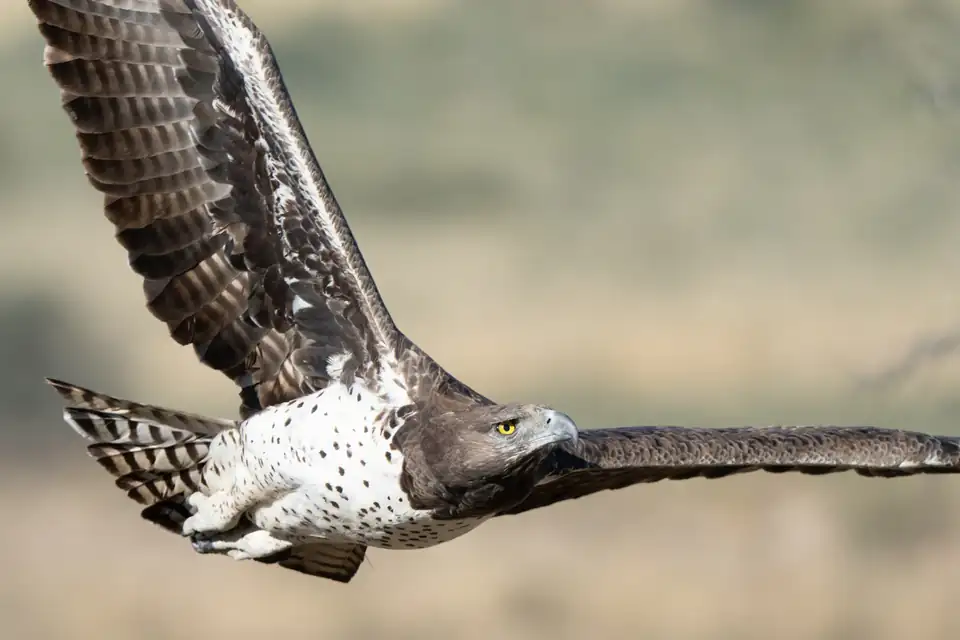
- Look for: a dark brown head, chest and upperparts, with white underparts covered in small dark spots, a short crest, and bright yellow eyes.
- Young birds: much paler, with whitish heads and underparts, which can cause confusion.
- In flight: the dark head and chest contrast with the pale, spotted belly, and the underwings are dark.
How it hunts
Martial eagles spend long periods soaring high over open country, and they are said to spot prey from several kilometres away. They then drop in a long, fast, angled stoop. More than 170 prey species have been recorded, from guineafowl, francolins and bustards to monitor lizards, hyraxes, young antelopes and monkeys. Pairs build huge stick nests, often well over a metre across, in large trees, and usually raise a single chick.
Why it’s Endangered
In 2020 the martial eagle was reassessed as Endangered on the IUCN Red List, after steep declines across much of its range. The main threats are:
- Persecution: eagles are shot or trapped by farmers who fear for their livestock, even though the real losses are widely considered to be exaggerated.
- Poisoning: baits laced with poison to kill predators are also taken by eagles.
- Power lines: electrocution and collisions are a growing problem.
- Habitat loss: as savanna is converted to farmland, prey and nest trees disappear.
Because pairs breed slowly and need very large territories, the loss of even a few adults can have a big effect. Protected areas are becoming increasingly important for the species.
Where to see it in Uganda
Martial eagles are birds of open savanna and woodland, so Uganda’s big savanna parks are the places to look. Sightings are never guaranteed, but they are possible on game drives in:
- Queen Elizabeth National Park, across the Kasenyi plains and in the south around Ishasha.
- Murchison Falls National Park, north of the Nile.
- Kidepo Valley National Park, one of the best raptor parks in the country.
- Lake Mburo National Park, where the open acacia country suits it well.
Don’t confuse it with…
The bird most often mistaken for a martial eagle is the black-chested snake eagle. It has a similar dark head and chest, but its white belly is plain rather than spotted, it’s noticeably smaller, and it has a rounder, owl-like head. Pale young martial eagles can also be confused with other large raptors, so it’s worth asking your guide to talk you through the details.
While you’re scanning for martials, Uganda’s savanna parks offer plenty of other raptors: the African fish eagle calling over the water, the bateleur rocking on the wind, tawny eagles, long-crested eagles on roadside posts and, in Kidepo, the secretary bird striding through the grass. In the forests of Kibale and Bwindi, keep an eye out for the crowned eagle, a specialist monkey hunter.
Practical tips
- Scan the treetops. Martial eagles often perch high on a dead branch with a wide view.
- Watch the sky mid-morning. Once the air warms up, large raptors take to the thermals.
- Keep your distance. Don’t ask your driver to approach a nest. Disturbance can make adults abandon it.
- Bring a zoom lens. A 300–400 mm lens or a good bridge camera helps a lot.
Good to know
Seeing a martial eagle on a Uganda safari is a bonus rather than something to plan a whole trip around. The good news is that the same parks give you lions, elephants and a huge variety of other birds. Our guide to the Big Five in Uganda explains which park is best for what.
Plan it with us
Tell us you’d love to see big raptors and we’ll lean your itinerary towards open savanna parks, with guides who know where the local pairs hunt. Get in touch and we’ll put together a plan.
Found this useful? Send it to someone planning a trip.