
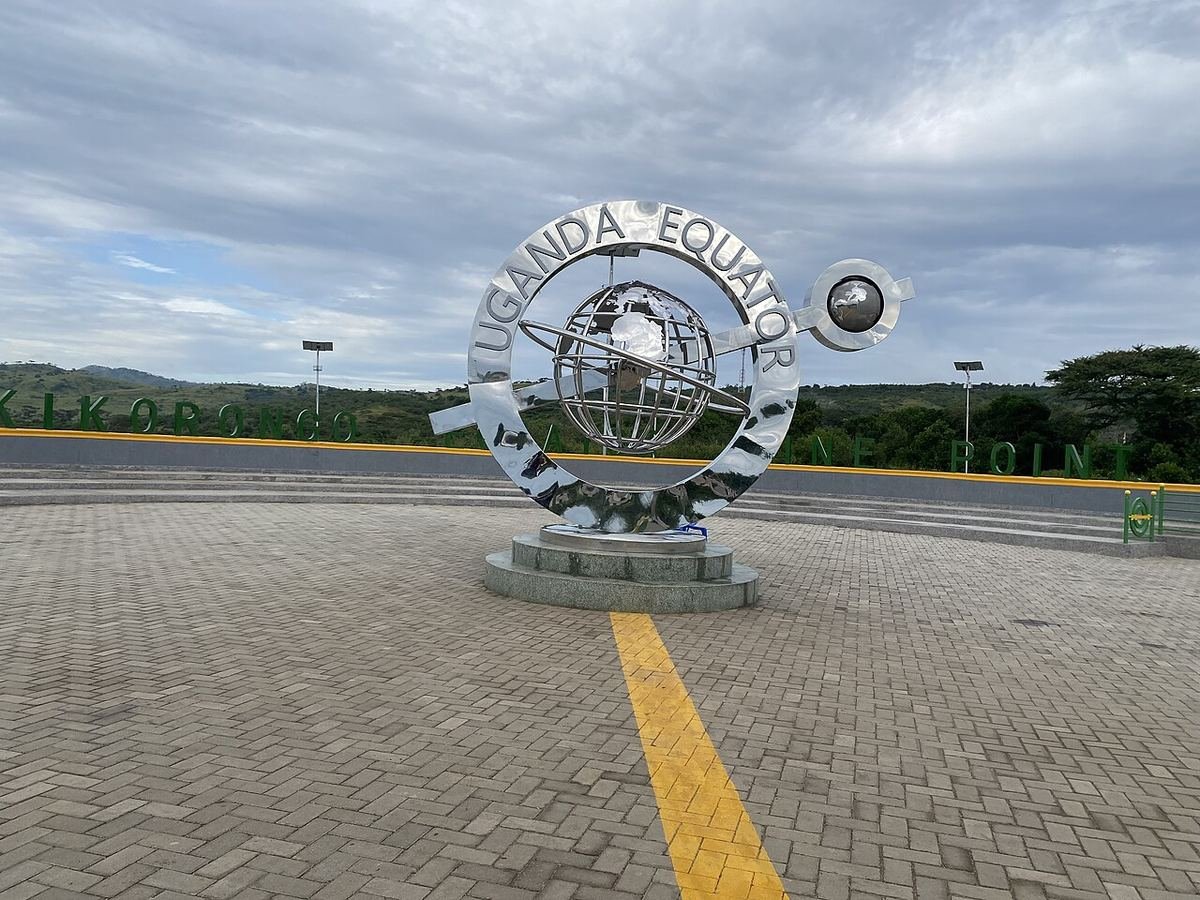
Uganda is one of a handful of countries the Equator runs straight through, and on many safaris you’ll cross it at least once. Standing with one foot in each hemisphere is a fun moment, and the stops along the road have become a small attraction of their own. Here’s where to cross it, what to expect, and a little honest science about the famous water demonstration.
Kayabwe, on the Masaka road
The best-known crossing is at Kayabwe, in Mpigi District, on the Kampala–Masaka highway, about 80 km south-west of Kampala. Almost everyone heading to Lake Mburo, Bwindi or Lake Bunyonyi passes it, usually an hour and a half or so into the drive.
You’ll find the Equator monuments, a line to stand on, craft shops, cafés and restrooms. It’s a natural first stretch-your-legs stop on the long drive west, and a good place to buy a coffee and a souvenir.
Kikorongo, near Queen Elizabeth
The second crossing most travellers meet is at Kikorongo in Kasese District, on the main road along the northern edge of Queen Elizabeth National Park. For years it was marked by two simple concrete rings, one on each side of the road; these have since been replaced by a newer monument with a painted line across the paving. The Equator also crosses the park itself, and there are markers inside the northern part of the park too.
If you travel from Kibale or Fort Portal down to Queen Elizabeth, you cross here on the way to Mweya and the Kazinga Channel.
The water demonstration
At Kayabwe you’ll probably be offered a demonstration. A guide fills a basin with a hole in the bottom, adds a few matchsticks or leaves, and pulls the plug a few metres north of the line, a few metres south, and right on it. The water appears to swirl one way in the north, the other way in the south, and straight down on the line.
It’s entertaining, but it isn’t the Coriolis effect, and we’d rather you knew that. Here’s why:
- The Coriolis effect is real and shapes huge systems like hurricanes and ocean currents, which spin in opposite directions in each hemisphere.
- But its force is tiny over small distances and short times. In a basin that drains in a few seconds, it is millions of times weaker than the small movements already in the water, from filling, carrying or tilting the basin.
- Right at the Equator, the horizontal part of the effect is zero, and a few metres either side it is still vanishingly small.
- So the direction of the swirl comes from how the water is poured and how the basin is turned or set down. A skilled demonstrator can make it go whichever way they like.
Physicists have shown that you can only detect the Coriolis effect in a draining tank under carefully controlled laboratory conditions, with a large, very still tank left to settle for many hours. By all means enjoy the show and tip the guide, but treat it as a bit of theatre, not a science lesson.
Other things people claim
- “You weigh less on the Equator.” Very slightly, yes, because of the Earth’s spin and shape, but far too little to notice on a bathroom scale.
- “You can balance an egg on a nail.” You can do that anywhere with enough patience; the Equator doesn’t help.
- “The line is exact.” Monuments are markers, not survey points. Open the map on your phone and see how close you are.
Practical tips
- Allow 20 to 30 minutes for photos and a break.
- Traffic on the Masaka road can be heavy leaving Kampala, so an early start makes the Equator stop a relaxed breakfast or coffee break rather than a rush.
- Carry some Uganda shillings for coffee, crafts or a tip for the demonstration.
- The sun is strong at midday on the Equator, even when it feels cool, so wear a hat and sunscreen.
- Look out for bargains: Kayabwe’s craft shops have baskets, carvings and bark-cloth items.
The Equator stop is a small, happy part of a Uganda road trip, and a reminder of how far you’ve come. If you’d like help planning the route, whether it’s south to the gorillas or west to Queen Elizabeth, get in touch and we’ll map it out together.
Found this useful? Send it to someone planning a trip.


