
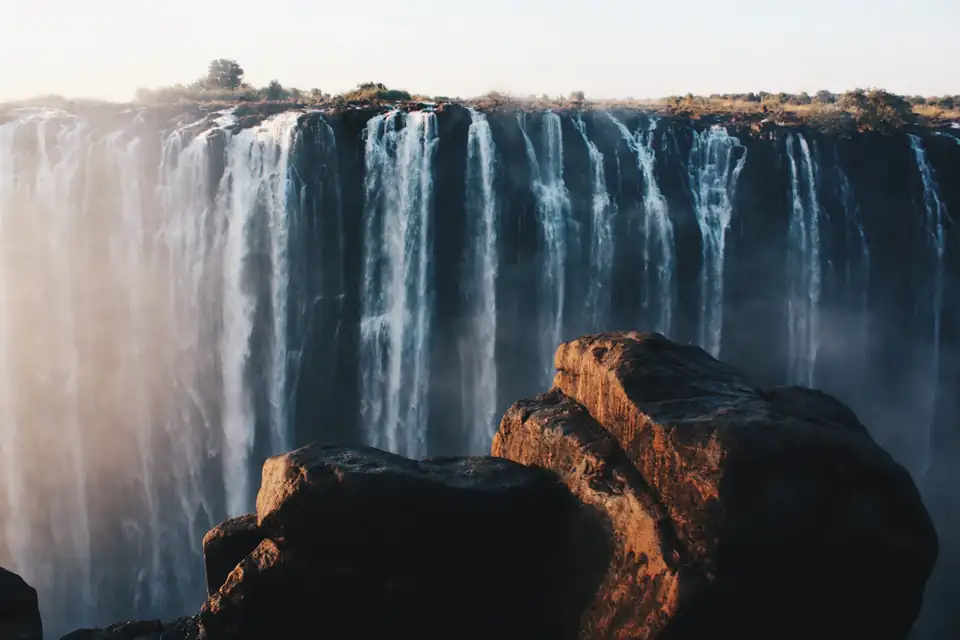

Africa’s waterfalls come in every shape: a mile-wide curtain, a river forced through a crack in the rock, a thin ribbon dropping off a mountain wall. Here are the ones we think every traveller should know about, with the key facts and the best time to see them.
Victoria Falls (Zambia and Zimbabwe)
The Zambezi drops about 108 metres over a front roughly 1,708 metres wide, making Victoria Falls the largest sheet of falling water in the world. Its local name, Mosi-oa-Tunya, means “the smoke that thunders”. It became a UNESCO World Heritage Site in 1989.
- When to go: the flow peaks from about February to May, highest in April, when the spray can hide the falls. From September to December the flow is much lower, the views clearer, and the famous Devil’s Pool on the Zambian side is usually open.
Murchison Falls (Uganda)
At Murchison Falls, the whole Victoria Nile squeezes through a gap in the rock only about seven metres wide, then plunges around 43 metres. It isn’t the tallest waterfall on this list, but it may be the most powerful to stand beside.
- Don’t miss: a boat trip upriver to the foot of the falls, past hippos and crocodiles, then the hike to the top.
- When to go: impressive all year. The drier months are best for game drives in the park.
Sipi Falls (Uganda)
Sipi Falls is a chain of three waterfalls on the slopes of Mount Elgon, in eastern Uganda. The highest drops about 100 metres. Walk between them through coffee farms, try some local Bugisu Arabica, or abseil beside the main fall.
- When to go: fullest in the rains, easiest to hike in the drier months.
Blue Nile Falls, or Tis Abay (Ethiopia)
About 30 km from Bahir Dar, the Blue Nile drops about 42 metres. The Amharic name Tis Abay means “great smoke”. A hydroelectric plant, operating since 2003, takes much of the water, so in the dry season the falls can be a fraction of their old size. Nearby is a stone bridge built in the 17th century, said to be the first of its kind in Ethiopia.
- When to go: in and just after the rainy season, when the falls can spread to more than 400 metres wide.
Kalambo Falls (Zambia and Tanzania)
On the border near the southern end of Lake Tanganyika, Kalambo Falls drops about 235 metres in a single fall, one of the tallest uninterrupted drops in Africa. It’s also a major archaeological site. In 2023, researchers announced wooden structures here dated to around 476,000 years old, the earliest known example of wood being used to build a structure.
Tugela Falls (South Africa)
In the Drakensberg, in Royal Natal National Park, the Tugela River drops off the Amphitheatre in five steps. Its total height was long given as 948 metres. A 2016 survey suggested about 983 metres, and some argue that makes it taller than Venezuela’s Angel Falls. The debate goes on.
- When to go: after the summer rains. In the dry winter it can shrink to a trickle.
Augrabies Falls (South Africa)
In the Northern Cape, the Orange River drops about 56 metres into a granite gorge some 240 metres deep and 18 km long. The name comes from a Khoikhoi word meaning “place of great noise”.
Ouzoud Falls (Morocco)
In the Atlas mountains, about 150 km from Marrakesh, the Ouzoud cascades drop around 110 metres in three steps. The name comes from a Berber word linked to grinding grain, after the old mills on the river. Barbary macaques are often seen along the paths.
Practical tips
- Waterfall paths are wet and slippery. Wear shoes with good grip.
- Bring a waterproof bag for your phone and camera. The spray at big falls soaks everything.
- High water is dramatic but can hide the view. Moderate flow is often best for photos.
- In Uganda, Murchison and Sipi fit easily into a wider safari. See our nature walks for ideas.
Would you like to add a waterfall to your trip? We can build Murchison, Sipi or the Nile at Jinja into your Uganda safari. Just ask.
Found this useful? Send it to someone planning a trip.


